


Article
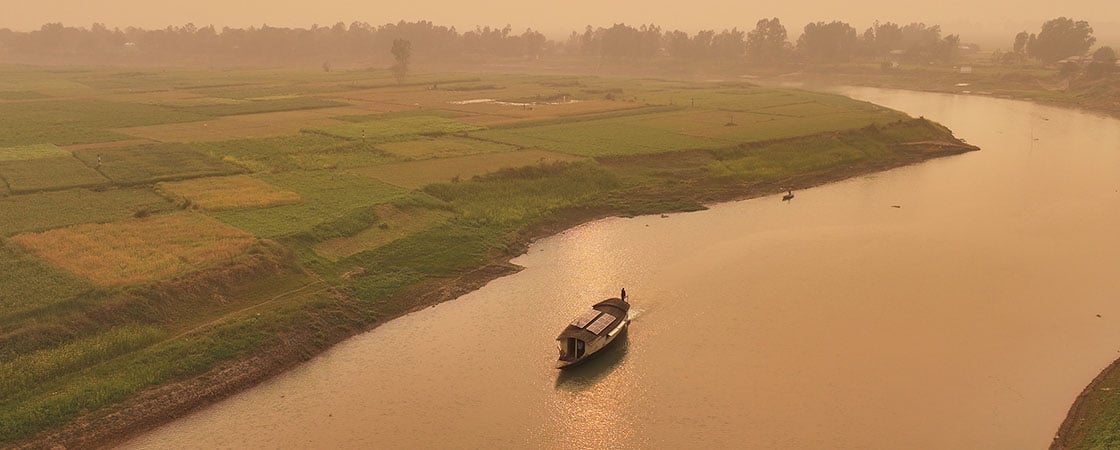
Sheikh Shamim Somudro/Shidhulai Swanirvar Sangstha

What If This Were Your School?

For decades, massive floods in Bangladesh made it impossible for many kids to get to school. Then one of those kids grew up and wondered, What if the classroom came to them? 

By Allison Friedman
From the May 2026 Issue

Learning Objective: to determine the central idea in a narrative nonfiction article

Lexiles: 1030L, 800L

Standards

Download and Print
AS YOU READ

Consider how the environment can affect our lives.

During the dry season, from November to March, Amina’s* village is lush and peaceful. Long vines curl around a cluster of one-story tin homes as leafy banana trees sway overhead. Bright-green rice fields stretch toward the horizon, crisscrossed by dirt roads. The rushing of a nearby river creates a calming murmur.  

But now, in the rainy season, much of the village has disappeared. Flooding has swallowed up the roads and fields. The river’s gentle murmur has become an angry roar. Amina’s house is surrounded, a little island in a vast sea.

This doesn’t stop Amina. She steps out into the knee-deep water and wades carefully to the riverbank, where a handful of other kids are already waiting. A long, covered wood-and-bamboo boat soon pulls up, and Amina and the others climb aboard.

They’re not heading out on a trip—in fact, they’re not going anywhere. This boat is their school. 

Inside the cabin are all the features of a typical classroom: rows of wooden desks and benches, shelves packed with books, computers. A teacher stands in front of a blackboard, ready with the day’s lessons. This floating school allows Amina and her classmates to keep learning, even as flooding shuts down other schools in the area or makes them impossible to reach.

“When everything is underwater, this school is our only hope,” Amina says.

During the dry season, from November to March, Amina’s* village is lush and peaceful. Long vines curl around a cluster of one-story tin homes. Leafy banana trees sway overhead. Bright-green rice fields stretch toward the horizon, crisscrossed by dirt roads. The flow of a nearby river creates a calming murmur.

But now it’s the rainy season. Much of the village has disappeared. Flooding has swallowed up roads and fields. The river’s murmur has become an angry roar. Amina’s house is surrounded by water.

This doesn’t stop Amina. She steps out into the knee-deep water. She wades carefully to the riverbank. A handful of other kids are already there. A boat pulls up. Amina and the others climb aboard.

They’re not going on a trip. In fact, they’re not going anywhere. This boat is their school.

The cabin on the boat has all the features of a typical classroom. It has rows of wooden desks and benches, shelves packed with books, and computers. A teacher stands in front of a blackboard with the day’s lessons. The flooding has shut down other schools in the area or made them impossible to reach. But this floating school allows Amina and her classmates to keep learning.

“When everything is underwater, this school is our only hope,” Amina says.

Mohammed Rezwan/Shidhulai Swanirvar Sangstha

Amina* at her school.

Slowly Drowning

Slowly Drowning

Amina’s floating school is one of dozens across Bangladesh. The idea for the schools was dreamed up more than 25 years ago by an architect named Mohammed Rezwan. Like Amina, Rezwan grew up in the northwestern part of the country, and his childhood was also shaped by flooding. “Life was dominated by water and decided by water,” he says.

Bangladesh has always been prone to flooding: Most of the country lies barely above sea level, and from June to October, heavy monsoon rains drench the landscape. But experts agree that climate change has made the situation worse. 

Glaciers in regions to the north of Bangladesh, like India, Nepal, and China, are melting, sending excess water into the country’s three major rivers, as well as hundreds of connected streams. The excess water causes those waterways to overflow and grow wider as the rushing water eats away at the land around them. Meanwhile, the sea level is rising to the south of the country in the Indian Ocean, and monsoon rains are becoming heavier and more unpredictable.

The result is that Bangladesh is slowly drowning. One-fifth of the country floods each year during monsoon season, with as much as two-thirds covered in years of particularly extreme flooding. Hundreds of thousands of homes and buildings are damaged or destroyed. In some places, the floodwaters can reach 10 feet high, and travel becomes possible only by boat.

An international panel on climate change has estimated that 17 percent of the country could be permanently underwater by 2050. And Bangladesh is one of the most densely populated countries in the world, with 176 million people (about half the population of the U.S.) living in an area the size of Wisconsin. Losing that much land to flooding would leave 20 million people homeless.

Amina’s floating school is one of dozens across Bangladesh. An architect named Mohammed Rezwan came up with the idea more than 25 years ago. Like Amina, Rezwan grew up in the northwestern part of the country. His childhood was also shaped by flooding. “Life was dominated by water and decided by water,” he says.

Bangladesh has always been prone to flooding. Most of the country lies barely above sea level. From June to October, heavy monsoon rains drench the landscape. But experts agree that climate change has made the situation worse.

India, Nepal, and China are north of Bangladesh. They have glaciers. But they are melting. This sends water into Bangladesh’s three major rivers and hundreds of connected streams. The excess water causes those waterways to overflow. They also grow wider as the rushing water eats away at the land around them. Meanwhile, the sea level is rising to the south of the country in the Indian Ocean. And monsoon rains are becoming heavier and more unpredictable.

The result is that Bangladesh is slowly drowning. One-fifth of the country floods each year during monsoon season. As much as two-thirds of the country is covered when the flooding is extreme. Hundreds of thousands of homes and buildings are damaged or destroyed. In some places, the floodwaters can reach 10 feet high. Travel becomes possible only by boat.

An international panel on climate change has estimated that 17 percent of the country could be permanently underwater by 2050. Bangladesh is one of the most densely populated countries in the world. It has 176 million people. (That’s like about half the population of the U.S. living in an area the size of Wisconsin.) Losing 17 percent of the land to flooding would leave 20 million people homeless.

Johan Bjerke/47 million children’s World’s Children’s Prize/www.worldschildrensprize.org

Mohammed Rezwan (circled) dreamed up his idea of floating schools more than 25 years ago. Now dozens of boat schools operate in Bangladesh. 

Floating Schools

Floating Schools

Rezwan remembers how when he was a child, his village would shut down during the rainy season. With farm land underwater, farmers could not grow anything, forcing many to travel to larger towns and cities in search of work. The flooded roads made it impossible for most kids to make it to school.

Rezwan was lucky: His family had a small boat for their farming business, which he used to get to class. But looking at his friends who were left behind, he felt the sting of unfairness. If children cannot go to school, can we bring the school to them? he remembers thinking. 

It was a question that stuck with him as he got older. Hardworking and studious, Rezwan won scholarships to study architecture at a college in Dhaka, the bustling capital of Bangladesh. But every time he visited home, he saw friends who had been forced to quit school, who could not find jobs, who did not have access to adequate health care—all because of the flooding.

Could he solve this problem?

Rezwan decided to try, using his architecture degree. He thought about how in some parts of the country, there were gardens and markets that floated on water. And soon the realization dawned on him: Why not floating schools? Floating libraries? Floating health clinics?

When Rezwan was a child, his village would shut down during the rainy season. Farmers could not grow anything. Many went to larger towns and cities to search of work. The flooded roads made it impossible for most kids to get to school.

Rezwan was lucky. His family had a small boat. He used it to get to class. But he saw his friends who were left behind. He felt the sting of unfairness. If children cannot go to school, can we bring the school to them? he remembers thinking.

The question stuck with him as he got older. Hardworking and studious, Rezwan won scholarships. He studied architecture at a college in Dhaka. That’s the capital of Bangladesh. But when he visited home, he saw friends who had been forced to quit school, who could not find jobs, who did not have access to adequate health care—all because of the flooding.

Could he solve this problem? 

Rezwan decided to try, using his architecture degree. He thought about the gardens and markets that floated on water in some parts of Bangladesh. And then he had a realization. Why not floating schools? Floating libraries? Floating health clinics?

Jim McMahon/Mapman® (map); Muhammad Amdad Hossain/NurPhoto via Getty Images (flood)

Flooding in Bangladesh

Bangladesh is particularly vulnerable to severe flooding because of its location. The country is on low-lying land where the Ganges and Brahmaputra rivers split into many branches. During the rainy season, these waterways often overflow.

By the People

By the People

Not long after graduation, Rezwan got to work. He founded a nonprofit organization called Shidhulai Swanirvar Sangstha, named after his home village (Shidhulai) and the Bangladeshi word for “self-reliance.” 

Rezwan spent four years trying to fundraise for his organization, emailing more than 100 charities to ask for support—but none of them agreed to donate. So instead, he raised the money by collecting scrap materials, like metal and plastic, to sell to factories.

Finally, in 2002, Rezwan and his small team were able to build the first boat school, in the area where he grew up. Using an old lifeboat as a base, volunteer builders constructed a main cabin to serve as a classroom. They used traditional Bangladeshi boat-building techniques and local materials like bamboo. Rezwan recalls standing on the deck of the completed boat and thinking, This is going to change the country.

At first, however, people were skeptical; no one had heard of a floating school before. “On day one, only one student came,” Rezwan remembers. But interest quickly grew as parents realized that their kids could get an education year-round, without interruption from the monsoons. “Within a week, seven came. Within a month, 30,” Rezwan says. 

Soon people in neighboring communities began requesting their own boat schools. More and more local volunteers stepped up to help build them, and Rezwan recruited local teachers. 

“The work we have been doing, it is not just for the people, it is by the people,” he says.

After graduation, Rezwan got to work. He founded a nonprofit organization called Shidhulai Swanirvar Sangstha. It’s named after his home village and is the Bangladeshi word for “self-reliance.”

Rezwan spent four years trying to fundraise for his organization. He emailed more than 100 charities to ask for support. But none of them agreed to donate. So instead, he raised the money by collecting scrap materials, like metal and plastic, to sell to factories.

Finally, in 2002, Rezwan and his small team were able to build the first boat school, in the area where he grew up. They used an old lifeboat. Volunteer builders constructed a main cabin on it to serve as a classroom. They used traditional Bangladeshi boatbuilding techniques. They used local materials like bamboo. Rezwan recalls thinking, This is going to change the country.

But at first, people were skeptical. No one had heard of a floating school before. “On day one, only one student came,” Rezwan remembers. But interest grew as parents realized that their kids could go to school without interruption from the monsoons. “Within a week, seven came. Within a month, 30,” Rezwan says.

Soon other communities began requesting boat schools. More local volunteers stepped up to help build them. Rezwan recruited local teachers.

“The work we have been doing, it is not just for the people, it is by the people,” he says.

Syed Mahamudur Rahman/NurPhoto via Getty Images (woman walking); Xinhua via Getty Images (boat)

“Right to Our Doorstep”

“Right to Our Doorstep”

Since the first boat school was constructed, more than 22,500 students have been educated in the schools—students like Amina.

Every morning, Amina and her classmates make their way to the riverbank and wait for their school to arrive. The boat makes three stops, picking up kids as close to their houses as possible. “The school comes right to our doorstep,” says Amina’s mom, Rahima.* “We don’t worry about safety or long walks for Amina. Education comes to her.”

Once all 30 students are on board, the boat docks, and the school day begins. Amina sits beside her best friend, Salma.* They whisper quietly to each other and share notes on their lessons, which cover math, science, social studies, English, and Bangla, the main language of Bangladesh. Bangla is Amina’s favorite subject, but she enjoys learning pretty much everything.

She especially loves working on the school’s computer. Rows of shiny blue solar panels on the roof of the boat capture energy from the sun, turning it into electricity that can power a computer with internet access. Amina and her classmates use it to watch educational videos and do independent research. In an area where two-thirds of people do not have internet access at home, this computer provides a portal to a world beyond their own.

The impact of the boat schools on educational outcomes has been dramatic. At regular schools in Bangladesh, which many kids cannot attend for much of the year, half of the students eventually drop out. But at the floating schools, almost every student graduates.

Since the first boat school was constructed, more than 22,500 students have been educated in the schools—students like Amina.

Every morning, Amina and her classmates make their way to the riverbank. They wait for their school to arrive. The boat makes three stops, picking up kids as close to their houses as possible. “The school comes right to our doorstep,” says Amina’s mom, Rahima.* “We don’t worry about safety or long walks for Amina. Education comes to her.”

Once all 30 students are on board, the boat docks. The school day begins. Amina sits beside her best friend, Salma.* They whisper quietly to each other and share notes on their lessons, which cover math, science, social studies, English, and Bangla. That’s the main language of Bangladesh. Bangla is Amina’s favorite subject. But she enjoys learning pretty much everything.

She especially loves working on the school’s computer. Rows of solar panels on the roof of the boat capture energy from the sun. It’s turned into electricity that can power a computer with internet access. Amina and her classmates use it to watch educational videos and do independent research. In an area where two-thirds of people do not have internet access at home, this computer provides a portal to a world beyond their own.

The impact of the boat schools on educational outcomes has been dramatic. At regular schools in Bangladesh, many kids cannot attend for much of the year. Half of the students eventually drop out. But at the floating schools, almost every student graduates.

Strengthening Resilience

Strengthening Resilience

Abir Abdullah/Shidhulai Swanirvar Sangstha

Mohammed Rezwan

Building on the success of the boat schools, Rezwan has taken what he has learned to help meet other needs in local communities across Bangladesh. His team at Shidhulai has built six floating health clinics to serve people in rural areas who don’t have easy access to medical care. They’ve also built additional floating gardens where people can grow food year-round, playground boats where kids can play when their neighborhoods are too wet and muddy, and library boats where people of all ages can read and access computers. 

Then there are floating training centers where adults can learn useful skills and how to grow special crops that are resistant to flooding. Rahima, Amina’s mom, has been taking classes at the training centers. “Now we grow crops and vegetables in better ways,” she says. “Our harvest has increased, and we have started saving money.” 

Rezwan says that Bangladeshis like Amina and her family are already a deeply resilient people. “After each flood, each cyclone, people rebuild their communities and bounce back,” he says. The goal of all his projects is to further strengthen that resilience, helping communities adapt to a changing climate. “This is our survival tool, a strategy for the future generation,” he says.

Based on what he learned from building boat schools, Rezwan is helping to meet other needs in communities across Bangladesh. His team at Shidhulai has built six floating health clinics. They serve people in rural areas who don’t have easy access to medical care. They’ve also built additional floating gardens. People can grow food year-round on them. And they’ve built playground boats where kids can play year-round and library boats where people of all ages can read and access computers.

Then there are floating training centers. Adults can learn useful skills. They can learn to grow crops that are resistant to flooding. Rahima, Amina’s mom, has been taking classes at the training centers. “Now we grow crops and vegetables in better ways,” she says. “Our harvest has increased, and we have started saving money.”

Rezwan says that Bangladeshis like Amina and her family are already a deeply resilient people. “After each flood, each cyclone, people rebuild their communities and bounce back,” he says. The goal of all his projects is to further strengthen that resilience, helping communities adapt to a changing climate. “This is our survival tool, a strategy for the future generation,” he says.

A Model for the Future

A Model for the Future

The problem of rising waters extends far beyond Bangladesh. As a result of climate change, the average global sea level has risen by more than 4 inches since 1993. A 2019 report by the nonprofit group Climate Central found that land currently home to 200 million people—mostly in countries across Asia—is at risk of becoming largely underwater by the year 2100.

Of course, the larger goal is to combat climate change and prevent such disasters from happening. But given the reality that this will take time, Rezwan hopes that in the meantime Bangladesh can serve as a model for other areas dealing with the same challenges. Already, he has helped bring his floating school system to 10 other countries around the world, including India, Cambodia, and Nigeria. He is currently working on bringing it to 10 more, an expansion that would reach about 1.5 million children globally. 

This work has earned Rezwan numerous honors over the years, including an award in 2025 from the United Nations. But he has said that he refuses to be satisfied with what he has accomplished so far—instead he continues to innovate to find solutions to ever-shifting global problems. And he hopes young people around the world will join him in this mission. “Always try to help others,” he advises them. “That is, I think, the purpose of life.”

It’s a lesson that Amina has taken to heart. “I want to become a doctor,” she says. “I want to make sure our poor people can get treatment.” She explains that Rezwan’s floating school has made that dream possible. “Before, I could have never imagined such a future,” Amina says. “Now, I can.” 

The problem of rising waters extends far beyond Bangladesh. As a result of climate change, the average global sea level has risen by more than 4 inches since 1993. A 2019 report by the nonprofit group Climate Central found that land currently home to 200 million people is at risk of becoming largely underwater by the year 2100. Most of that land is in countries across Asia.

Of course, the larger goal is to combat climate change and prevent such disasters from happening. But that will take a lot of time. In the meantime, Rezwan hopes that Bangladesh can serve as a model for other areas dealing with the same challenges. Already, he has helped bring his floating school system to 10 other countries, including India, Cambodia, and Nigeria. He is currently working on to bring it to 10 more. That expansion that would reach about 1.5 million children globally.

This work has earned Rezwan numerous honors over the years. In 2025, he won an award from the United Nations. But he doesn’t want to stop, satisfied with his accomplishments. Instead, he continues to look for solutions to ever-shifting global problems. And he hopes young people around the world will join him in this mission. “Always try to help others,” he advises them. “That is, I think, the purpose of life.”

It’s a lesson that Amina has taken to heart. “I want to become a doctor,” she says. “I want to make sure our poor people can get treatment.” She explains that Rezwan’s floating school has made that dream possible. “Before, I could have never imagined such a future,” Amina says. “Now, I can.” 

*Names have been changed for privacy

*Names have been changed for privacy

Icon of a lightbulb

Writing Prompt

Rezwan says that his life “was dominated by water and decided by water.” What does he mean by this? How did he respond to this challenge? 

Writing Prompt

Rezwan says that his life “was dominated by water and decided by water.” What does he mean by this? How did he respond to this challenge? 

This article was originally published in the May/June 2026 issue.

This article was originally published in the May/June 2026 issue.

video (1)
Audio ()
Activities (5)
Quizzes (1)
Answer Key (1)
video (1)
Audio ()
Activities (5)
Quizzes (1)
Answer Key (1)
Text-to-Speech