

Article
Shutterstock.com

Surrounded by Lions

Lauren Tarshis takes you on a virtual field trip to the Okavango Delta in Botswana, looking for one of Earth’s fiercest predators.

By Lauren Tarshis
From the May 2026 Issue

Learning Objective: to synthesize key ideas from a personal narrative and an interview with the author

Lexiles: 810L, 700L

Standards

Story Navigation

Download and Print
AS YOU READ

How does Tarshis pull you into her story?

Surrounded by Lions

I traveled to the wilds of Africa to see lions up close. Here’s what it was like to come face-to-face with one of the world’s most feared predators.

Courtesy of David Dreyfuss

Author Lauren Tarshis traveled 30 hours to reach the Okavango Delta to research her new I Survived book. 

Shutterstock.com

A  reedbuck

I stare at dark drops of blood on the dusty ground. Nearby, huge paw prints are pressed deep into the dirt. At least three lions were here. Maybe more. 

A few feet away, there’s a pair of long, curving animal horns. Those horns and the drops of blood are all that’s left of a deerlike animal,
a reedbuck.  Lions followed it, killed it, and then devoured it. 

My heart pounds as I stare at this lethal scene.

Just two days ago, I was at my home in Connecticut. There, the wildest beast I know is my poodle, Roy. Now, on this September day, I’m 8,000 miles away, in the African country of Botswana. 

I’m here for a week, exploring one of the wildest places on the planet. It is called the Okavango Delta, and it’s a sweeping wetland in the middle of a desert. Bigger than New York City, Los Angeles, Houston, and Chicago put together, it’s all trees and grass and swamps and water. There are no towns, no paved roads, and very few people. It is a land set aside just for animals. 

Close your eyes and imagine the most dazzling African wilderness from your dreams. All around you is a green and golden land, with twisting streams and sparkling ponds. Hippos and crocodiles splash in the water. Huge herds of elephants stroll slowly through the trees. Zebras, giraffes, and cape buffalo nibble on fresh grass. Rainbow-colored birds flash by. 

This is the Okavango Delta.

I stare at drops of blood on the dusty ground. Nearby, I see huge paw prints pressed into the dirt. At least three lions were here. Maybe more.

A few feet away, there’s a pair of animal horns. Those horns and the drops of blood are all that’s left of a reedbuck. That’s a deerlike animal. Lions followed it, killed it, and then devoured it.

My heart pounds as I stare at this lethal scene. Just two days ago, I was at my home in Connecticut. There, the wildest beast I know is my poodle, Roy. Now, on this September day, I’m 8,000 miles away, in the African country of Botswana.

I’m here for a week, exploring one of the wildest places on the planet. It is called the Okavango Delta. It’s a sweeping wetland in the middle of a desert. It’s bigger than New York City, Los Angeles, Houston, and Chicago put together. But it’s all trees, grass, swamps, and water. There are no towns, no paved roads, and very few people. It is a land set aside just for animals.

Close your eyes. Imagine the most dazzling African wilderness from your dreams. All around you is a green and golden land, with twisting streams and sparkling ponds. Hippos and crocodiles splash in the water. Herds of elephants stroll through the trees. Zebras, giraffes, and cape buffalo nibble on fresh grass. Rainbow-colored birds flash by.

This is the Okavango Delta.

Jim McMahon/Mapman® (map); Courtesy of David Dreyfuss (elephants); Shutterstock.com (all other images)

Most of Botswana is a desert. But from November to April, the rainy season transforms the Okavango Delta into a lush wetland. It’s home to thousands of animals, from elephants and hippos to wild dogs and giraffes.

Realistic and Exciting

Realistic and Exciting

Shutterstock.com

I’ve come here to research a book I’m writing—the newest story in my I Survived series. This one is about an American boy whose plane crashes in this wilderness. Injured and terrified, he must survive a harrowing night surrounded by lions and other fierce predators.

I hope to learn all I can about this place and its animals, especially lions, so that I can ultimately write a book that is as realistic and exciting as possible. 

With me today is a man named Esefa Mokopi. He grew up in a village at the edge of the Okavango Delta. He then went to school to be trained as a wilderness guide. 

Esefa can name any animal by its paw print, any bird by its song, any insect by its buzz. Now he crouches low, studying the paw prints in the dirt. He examines the horns and points to the bloody bits of flesh still clinging to them.

“This kill happened within the last hour or so,” he says. “The lions must be close.”

This is what I’ve been waiting for, my chance to see these majestic cats up close. My heart pounds in my chest.  

But do I really want to come face-to-face with one of the world’s most feared predators?

I’ve come here to research a book I’m writing. It’s for my I Survived series. This one is about an American boy. His plane crashes in this wilderness. Injured and terrified, he must survive a harrowing night surrounded by lions and other fierce predators.

I hope to learn all I can about this place and its animals, especially lions. Then I can write a book that is as realistic and exciting as possible.

With me today is a man named Esefa Mokopi. He grew up in a village at the edge of the Okavango Delta. He went to school to train as a wilderness guide.

Esefa can name any animal
by its paw print, any bird by its song, and any insect by its buzz. Now he crouches low. He studies the paw prints in the dirt. He examines the horns. He points to the bloody bits of flesh still clinging to them.

“This kill happened within the last hour or so,” he says. “The lions must be close.”

This is it! My chance to see lions up close. My heart pounds.

But do I really want to come face-to-face with one of the world’s most feared predators?

Courtesy of David Dreyfuss

Wilderness guide Esefa Mokopi shows Lauren the horns of the reedbuck that was attacked.

Lion Superpowers

Lion Superpowers

Shutterstock.com

Lions truly are the kings (and queens) of this African wilderness. Cheetahs are the fastest. Elephants are the largest. Hippos have jaws that can demolish a skull. Wild dogs can chase their prey for hours without tiring. 

But lions rule. A full-grown male can weigh as much as you and five of your friends combined. Their sharp claws can hook into flesh and slice like knives. Their long teeth can crush bone. They can sprint up to 50 miles per hour. 

Lions’ real superpower, though, is teamwork. 

They are the only big cats that live and hunt in groups, called prides. A pride usually includes several lionesses, their cubs, and a few males. Mostly it’s the lionesses that hunt. They move together, like dancers on a grassy stage. To bring down an animal far larger than themselves—like a 2,000-pound cape buffalo or a young giraffe— they surround their prey, cut off escape routes, and attack.

I remind myself that we humans are not lion prey. Attacks on humans are extremely rare. They usually happen only if a lion is injured, surprised, or protecting cubs. Elephants and hippos kill far more humans here than lions do. 

I look at Esefa. 

“I’m ready,” I say. 

Lions are the kings (and queens) of this African wilderness. Cheetahs are the fastest. Elephants are the largest. Hippos have jaws that can demolish a skull. Wild dogs can chase their prey for hours without tiring.

But lions rule. A full-grown male can weigh as much as you and five of your friends combined. Their sharp claws can hook into flesh and slice like knives. Their long teeth can crush bone. They can sprint up to 50 miles per hour.

Lions’ real superpower, though, is teamwork.

They are the only big cats that live and hunt in groups, called prides. A pride usually includes several lionesses, their cubs, and a few males. Mostly it’s the lionesses that hunt. They move together, like dancers on a grassy stage. They can bring down an animal far larger than themselves—like a 2,000-pound cape buffalo or a young giraffe. How? They surround their prey, cut off escape routes, and attack.

I remind myself that humans are not lion prey. Attacks on humans are extremely rare. They usually happen only if a lion is injured, surprised, or protecting cubs. Here, elephants and hippos kill far more humans than lions do.

I look at Esefa.

“I’m ready,” I say.

A Jolt of Fear

A Jolt of Fear

Shutterstock.com

We drive off the dirt path and cross a deep stream. Esefa goes slowly, scanning all around us. It’s eerily quiet. We circle around a big tree. Then Esefa stops the car. 

That’s when I see it. Something moving—something big. 

It’s a large lioness. 

No. 

There are two. Three. Four. Five. 

Five female lions—and they are coming right toward us. 

A jolt of fear grips me. I forget what I’ve learned about lions usually not attacking humans. 

All I can think is this: I am just another animal, flesh and blood, like that reedbuck. This jeep has wide-open sides—it would be nothing for the lions to jump in.

I expect the cats to growl, to show their teeth. I brace myself. 

But the lions don’t even glance our way. This is what Esefa said would happen. To the lions here, our jeep—and the people inside it—is no more exciting than a passing cloud. Why? Part of the reason is because hunting lions is not allowed here. These animals have likely never heard a gunshot. They have never been chased by a jeep. Instead, they’ve become used to the sight of the vehicles—which stay out of their way—and do not view them as threats they need to act aggressively toward. 

Sadly, lions are not guaranteed this safety everywhere. Right now, wild lions are fighting for their survival.

We drive off the dirt path. We cross a deep stream. Esefa goes slowly, scanning all around us. It’s quiet. We circle around a big tree. Then Esefa stops the car.

That’s when I see it. Something moving—something big.

It’s a large lioness.

No. 

There are two. Three. Four. Five.

Five female lions. They are coming right toward us.

A jolt of fear grips me. I forget that lions usually don’t attack humans.

Instead, I think: I am just another animal, like that reedbuck. This jeep has open sides. The lions could jump in.

I expect the cats to growl, to show their teeth. I brace myself.

But the lions don’t even glance our way. This is what Esefa said would happen. To the lions here, our jeep—and the people inside it—is no more exciting than a passing cloud. Why? Because hunting lions is not allowed here. These animals have likely never heard a gunshot. They have never been chased by a jeep. Instead, they’ve become used to the sight of the vehicles—which stay out of their way. So they do not view them as threats.

Sadly, lions are not guaranteed this safety everywhere. Right now, wild lions are fighting for their survival.

Chaithanya Krishnan/Alamy Stock Photo

The Okavango Delta is one of the few places on Earth where lions can still thrive. There are about 1,200 currently living there. 

At Risk

At Risk

Hundreds of years ago, there were likely about 500,000 lions roaming the planet. They lived across almost all of Africa, as well as in parts of Europe and Asia. 

But over time, humans began hunting lions—shooting, trapping, or poisoning the animals, killing thousands of them. And as farms, towns, and cities spread, lions lost the land they needed to find food. Little by little, they were pushed out—until they could only be found in Africa.

Even there, these creatures have not been safe.

Scientists estimated there were about 100,000 lions left in Africa in the early 1900s. Today only around 20,000 remain. Most live in just three countries: Tanzania, Kenya, and Botswana. These places protect large wilderness areas that are for animals only, and have banned or tightly limited lion hunting.

One of these protected areas is the Okavango Delta. It’s one of the last places on Earth where lions have a chance to thrive.

Hundreds of years ago, there were likely about 500,000 lions roaming the planet. They lived across almost all of Africa, as well as in parts of Europe and Asia.

But over time, humans began hunting lions. They shot, trapped, or poisoned the animals, killing thousands of them. As farms, towns, and cities spread, lions lost the land they needed to find food. Little by little, they were pushed out. Eventually, they could only be found in Africa.

Even there, these creatures have not been safe.

Scientists estimated there were about 100,000 lions left in Africa in the early 1900s. Today only around 20,000 remain. Most live in just three countries: Tanzania, Kenya, and Botswana. These places protect large wilderness areas that are for animals only. They have banned or tightly limited lion hunting.

One of these protected areas is the Okavango Delta. It’s one of the last places on Earth where lions have a chance to thrive.

Time to Rest

Time to Rest

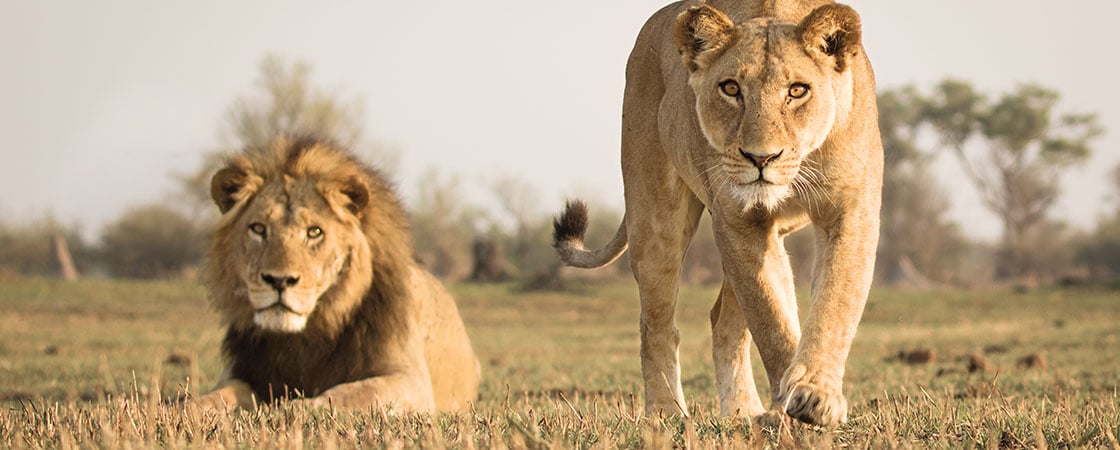
I think of this as I watch the lions come closer. They are now barely 5 feet away—so close I can see their muscles rippling under their fur. I can see their long lashes and the flecks of brown in their beautiful golden eyes. I can see each of their whiskers, the fleshy pads underneath their gigantic paws, the flies buzzing around their ears. 

All of their bodies have scars. Being a wild lion is hard, even here. They often go days without a kill. And to bring down prey, they must face slashing horns, stabbing tusks, and skull-cracking hooves. 

Now, after a big meal, it’s time for the lions to rest.

One by one, they plop themselves down. They huddle together, tails intertwined, paws touching. Some lie on their backs, their pale bellies facing the blue sky. Others curl up like house cats. 

I take notes and think about how I will bring all of this to life in my I Survived book. 

But mostly I just sit there with Esefa, watching. I am surrounded by lions, and I can’t remember a time when I’ve felt luckier. 

I think of this as I watch the lions come closer. They are now barely 5 feet away. I can see their muscles rippling under their fur. I can see their long lashes and the flecks of brown in their golden eyes. I can see each of their whiskers, the fleshy pads underneath their gigantic paws, and the flies buzzing around their ears.

All of their bodies have scars. Being a wild lion is hard, even here. They often go days without a kill. And to bring down prey, they must face slashing horns, stabbing tusks, and skull-cracking hooves.

Now, after a big meal, it’s time for the lions to rest.

One by one, they plop themselves down. They huddle together, tails intertwined, paws touching. Some lie on their backs. Others curl up like house cats.

I take notes. I think about how I will bring all of this to life in my I Survived book.

But mostly I just sit there with Esefa, watching. I am surrounded by lions. I can’t remember a time when I’ve felt luckier. 

Author Chat With Lauren 

We sat down with author Lauren Tarshis to learn more about how she wrote her personal narrative. Here’s what she had to say.

Courtesy of David Dreyfuss

Lauren Tarshis in the Okavango Delta at sunset.

SCOPE: How is a personal narrative different from an autobiography or a memoir? 

SCOPE: How is a personal narrative different from an autobiography or a memoir? 

Lauren Tarshis: An autobiography is about your whole life. A memoir is telling the story of your life, usually through the lens of an event. And personal narrative is a subset of memoir where you’re telling a story about a moment in your life and pulling readers into your world—really making them feel like they are with you somewhere. 

Lauren Tarshis: An autobiography is about your whole life. A memoir is telling the story of your life, usually through the lens of an event. And personal narrative is a subset of memoir where you’re telling a story about a moment in your life and pulling readers into your world—really making them feel like they are with you somewhere.

Courtesy of David Dreyfuss

How do you help readers feel like they are inside the moment with you?

How do you help readers feel like they are inside the moment with you?

With a personal narrative, every sentence or two needs to be compelling to readers. But it also needs to give readers the opportunity to feel as much as possible. And there’s really nothing like stepping foot on the ground in the place you’re writing about. Getting the opportunity to go to the Okavango Delta helped me capture the wonder of this place—and the fear and awe I felt when I was there—and then share it with you to help you feel it too. I also watched hours and hours of documentaries and looked at so many photographs. Both can also help you immerse yourself.

With a personal narrative, every sentence or two needs to be compelling to readers. But it also needs to give readers the opportunity to feel as much as possible. And there’s really nothing like stepping foot on the ground in the place you’re writing about. Getting the opportunity to go to the Okavango Delta helped me capture the wonder of this place—and the fear and awe I felt when I was there—and then share it with you to help you feel it too. I also watched hours and hours of documentaries and looked at so many photographs. Both can also help you immerse yourself.

How do you decide which details to include in your stories and which to leave out?

How do you decide which details to include in your stories and which to leave out?

Courtesy of David Dreyfuss

That’s the hard part. You have to be pretty ruthless. You might think something is interesting as the writer, but that doesn’t mean it fits into the story. I learned so many fascinating details on my trip that I wanted to share with you, but I had to continually remind myself that ultimately there had to be a story—a very compelling story—with a beginning, a middle, and an end.

That’s the hard part. You have to be pretty ruthless. You might think something is interesting as the writer, but that doesn’t mean it fits into the story. I learned so many fascinating details on my trip that I wanted to share with you, but I had to continually remind myself that ultimately there had to be a story—a very compelling story—with a beginning, a middle, and an end.

What do you hope readers will think or feel after reading this story?

What do you hope readers will think or feel after reading this story?

When I decided to write this story, I wanted the reader to walk away with a very clear sense of this gorgeous place, and the real privilege I felt getting to be up close with these incredible creatures. I also wanted to spark curiosity about the Okavango Delta and inspire you to learn more.

When I decided to write this story, I wanted the reader to walk away with a very clear sense of this gorgeous place, and the real privilege I felt getting to be up close with these incredible creatures. I also wanted to spark curiosity about the Okavango Delta and inspire you to learn more.

Courtesy of David Dreyfuss

What advice would you give to a young writer who’s writing their first personal narrative?

What advice would you give to a young writer who’s writing their first personal narrative?

Writing is not a talent. It’s really something that you can learn to do. Before you start to write, think about what you want the reader to walk away with. And just remember, I’ve been writing for more than 35 years for kids, and I have to write many, many, many drafts. So don’t be afraid to write many, many, many drafts!

Writing is not a talent. It’s really something that you can learn to do. Before you start to write, think about what you want the reader to walk away with. And just remember, I’ve been writing for more than 35 years for kids, and I have to write many, many, many drafts. So don’t be afraid to write many, many, many drafts!

Copyright ©2026 by LAUREN TARSHIS

Copyright ©2026 by LAUREN TARSHIS

Icon of a lightbulb

Writing Prompt

Write your own personal narrative about one small but meaningful moment from your life. Choose a moment that changed you, surprised you, scared you, or helped you understand something in a new way. Use Tarshis’s tips and strategies to guide your writing.


Writing Prompt

Write your own personal narrative about one small but meaningful moment from your life. Choose a moment that changed you, surprised you, scared you, or helped you understand something in a new way. Use Tarshis’s tips and strategies to guide your writing.


This article was originally published in the May/June 2026 issue.

This article was originally published in the May/June 2026 issue.

Audio ()
Activities (4)
Quizzes (1)
Answer Key (1)
Audio ()
Activities (4)
Quizzes (1)
Answer Key (1)
Text-to-Speech