


Article
Bettmann Archive/Getty Images

Mountain of Fire

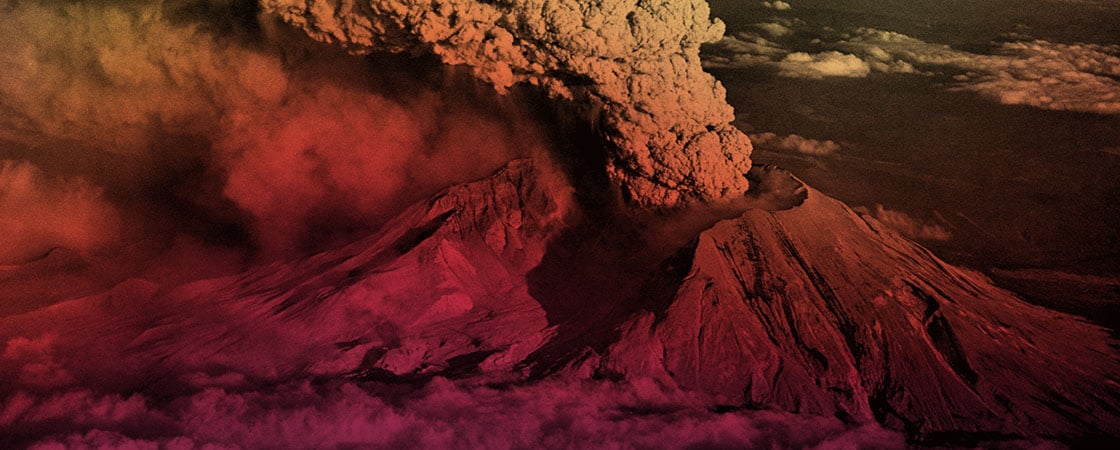
The eruption of Mount St. Helens, 1980

By Lauren Tarshis
From the March 2026 Issue

Learning Objective: to transform information from a narrative nonfiction text into a poem

Lexiles: 880L, 700L

Standards

AS YOU READ

How does the author help you understand what it was like to live through the eruption?

Ten-year-old Eric Smith did not imagine that the world around him was about to explode. 

It was May 18, 1980, a glorious Sunday morning. Eric was enjoying a boys’ weekend with his dad, Buzz, and his 7-year-old brother, Adam. They were camping in a forest of fir trees near Mount St. Helens, then the fifth-tallest mountain in Washington State. The mountain towered over them, its perfect peak sparkling with snow.

The family had spent the previous day hiking along forest trails. When night came, they had snuggled up in their tent and slept soundly under a sky illuminated by starlight. Now they were wide-awake, buzzing with excitement for another day of exploring. The woods were whisper quiet; the only sound was the sizzle of the bacon and eggs their dad was cooking on their camp stove. 

But all was not as peaceful as it seemed—because Mount St. Helens was not just a mountain. It was a volcano. And it was about to erupt.

Eric and Adam had just finished breakfast when a noise shattered the morning quiet. 

Crack! Crack! Crack!

Eric initially thought it was a hunter shooting his gun, but then he glimpsed something through the trees: a roiling gray cloud. It swept overhead, blocking out the sun. Moments later came an earsplitting roar, followed by a powerful blast of air. Eric stared in astonishment as 500-year-old trees toppled around them, flicked down as if they were as flimsy as cardboard. Hot ash poured from the sky. Strange rocks—hot and light—rained down, bouncing off their heads like Ping-Pong balls.  

Eric’s father grabbed the two boys, and they sprinted for safety under the trunk of a fallen tree. The ground shuddered. The air became searing hot, like an enormous dragon was huffing its fiery breath.

Make it stop! Eric’s mind screamed. Make it stop!

But the terror was only beginning.

Ten-year-old Eric Smith did not imagine that the world around him was about to explode.

It was May 18, 1980, a Sunday morning. Eric was with his dad, Buzz, and his 7-year-old brother, Adam. They were camping in a forest. It was near Mount St. Helens, then the fifth-tallest mountain in Washington State. The mountain towered over them. Its peak sparkled with snow.

The previous day, the family had hiked along forest trails. That night, they had snuggled up in their tent. They slept soundly. Now they were wide-awake, ready for another day of exploring. The woods were quiet. The only sound was the sizzle of the bacon and eggs their dad was cooking on their camp stove.

But all was not as peaceful as it seemed. Mount St. Helens was not just a mountain. It was a volcano. And it was about to erupt.

Eric and Adam finished their breakfast. Then a noise shattered the morning quiet.

Crack! Crack! Crack!

Eric thought it was a hunter shooting his gun. But then he spotted something through the trees. It was a roiling gray cloud. It swept overhead, blocking out the sun. Moments later came an earsplitting roar. It was followed by a powerful blast of air. Eric stared in shock as 500-year-old trees fell around them. Hot ash poured from the sky. Strange rocks—hot and light—rained down. They bounced off Eric’s head like Ping-Pong balls.

Eric’s father grabbed the two boys. They ran for safety under the trunk of a fallen tree. The ground shuddered. The air became searing hot, like the fiery breath of a dragon.

Make it stop! Eric’s mind screamed. Make it stop!

But the terror was only beginning.

Jim McMahon/Mapman ®

Mount St. Helens

Dangerous Weather Changes

Dangerous Weather Changes

About 1,500 of the volcanoes on Earth are active, meaning they have erupted at least once in the past 10,000 years and are likely to erupt again. Some, like Hawaii’s Kilauea, look like science book volcanoes, oozing lava and belching fire. Others are world-famous, like Italy’s Mount Vesuvius, which erupted in 79 A.D. and buried the city of Pompeii. 

Most active volcanoes, though, keep a low profile. They sit silently as people ski down their slopes or climb their rocky cliffs. Some wake up for a few weeks, release lazy puffs of ash, and then go back to sleep. Major volcanic eruptions, like the one at Vesuvius, happen rarely—once every decade or so. 

When they do happen, however, they tend to be catastrophic. In fact, no natural force on Earth has more destructive power. A  major earthquake can devastate a city. A powerful hurricane can wash away an entire town. A large tornado can suck a whole neighborhood into the clouds. But a major volcanic eruption can unleash more power than the largest nuclear bomb. It can kill tens of thousands and trigger pyroclastic flows: waves of superheated rock, ash, and gas.

Sometimes that’s only the beginning. A large eruption can blast hundreds of millions of tons of ash and rock miles into the sky. These ash plumes can circle the globe and block the sun’s rays, causing dangerous, long-term weather changes. For example, scientists suspect that a series of prehistoric volcanic eruptions millions of years ago caused mini ice ages that could have pushed some dinosaur species to extinction. More recently, in 1815, the eruption of Indonesia’s Mount Tambora created an enormous ash plume that caused worldwide weather changes for years. 

About 1,500 of Earth’s volcanoes are active. That means they have erupted at least once in the past 10,000 years and are likely to erupt again. Some, like Hawaii’s Kilauea, look like science book volcanoes. They ooze lava and belch fire. Others are world-famous, like Italy’s Mount Vesuvius. It erupted in 79 A.D. It buried the city of Pompeii.

Most active volcanoes, though, keep a low profile. They sit silently as people ski down their slopes or climb their cliffs. Some wake up for a few weeks. They release puffs of ash. Then they go back to sleep. Major volcanic eruptions, like the one at Vesuvius, rarely happen—once every decade or so.

When they do happen, however, they tend to be catastrophic. In fact, no natural force on Earth has more destructive power. A major earthquake can devastate a city. A powerful hurricane can wash away an entire town. A large tornado can suck a whole neighborhood into the clouds. But a major volcanic eruption can unleash more power than the largest nuclear bomb. It can kill tens of thousands and trigger pyroclastic flows. Those
are waves of superheated rock, ash, and gas.

Sometimes that’s only the beginning. A large eruption can blast hundreds of millions of tons of ash and rock miles into the sky.

These ash plumes can circle the globe and block the sun’s rays. That causes dangerous, long-term weather changes. Scientists suspect this happened millions of years ago, causing mini ice ages that could have pushed some dinosaur species to extinction. More recently, in 1815, Indonesia’s Mount Tambora erupted. It created an enormous ash plume, which caused worldwide weather changes for years.

Jeff Goulden/Getty Images (before eruption); Everett Collection Inc/Alamy Stock Photo (after eruption)

Dazzling Beauty to Ruined Land

For centuries, Mount St. Helens dazzled people with its perfect snow-capped cone, thickly forested slopes, and the crystal-blue waters of Spirit Lake. But after the eruption, virtually every living thing­—trees, plants, animals—within 230 square miles was killed. A massive landslide of volcanic debris, mud, and melted snow and ice swept away everything in its path. Spirit Lake was filled with ash and debris.


Left: Before the eruption


Right: After the eruption

An Ancient Terror

An Ancient Terror

Here in North America, 13 active volcanoes are lined up along America’s western edge, in a mountain range called the Cascades. This range stretches from California through Oregon and Washington and into British Columbia, Canada. 

Thousands of years ago, the Native Americans who lived on these lands witnessed the fearsome power of the Cascade volcanoes. Tribes told haunting myths explaining why the mountains sometimes exploded with fury. There was one volcano they feared above all others. The Cowlitz people called it Lawetlat’la—“the one from who smoke comes” or “the smoker.” In 1792, a British explorer gave it another name: Mount St. Helens. 

Mount St. Helens is the most active volcano in the Cascades. It has had at least four major eruptions over the past 500 years­. 

But in the late 1850s, Mount St. Helens went quiet.

Decades passed. Meanwhile, Washington became the 42nd American state. Seattle and other cities sprang up. Logging companies constructed thousands of miles of roads around the mountain, and nature lovers flocked to the area’s thick forests and rushing rivers. 

Eric’s dad worked as a logger on Mount St. Helens. He married Eric’s mother, and they moved to a house 8 miles from the mountain. Eric grew up hiking in the woods and boating in the crystal-blue waters of Spirit Lake, an especially beautiful spot at the base of Mount St. Helens.  

Like many people, the Smiths essentially forgot that their beloved mountain was actually a volcano. 

Here in North America, there are 13 active volcanoes along a mountain range called the Cascades. This range stretches from California through Oregon and Washington and into British Columbia, Canada.

Thousands of years ago, the Native Americans who lived on these lands witnessed the power of the Cascade volcanoes. Tribes told myths explaining why the mountains sometimes exploded with fury. They feared one volcano above all others. The Cowlitz people called it Lawetlat’la—“the one from who smoke comes” or “the smoker.” In 1792, a British explorer gave it another name: Mount St. Helens.

Mount St. Helens is the most active volcano in the Cascades. It has had at least four major eruptions over the past 500 years.

But in the late 1850s, Mount St. Helens went quiet.

Decades passed. Meanwhile, Washington became the 42nd American state. Seattle and other cities sprang up. Logging companies constructed thousands of miles of roads around the mountain. Nature lovers flocked to the area’s thick forests and rushing rivers.

Eric’s dad worked as a logger on Mount St. Helens. He married Eric’s mother. They moved to a house 8 miles from the mountain. Eric grew up hiking in the woods and boating in Spirit Lake, at the base of Mount St. Helens.

Like many people, the Smiths essentially forgot that the mountain was a volcano.

Mount St. Helens Wakes Up

Mount St. Helens Wakes Up

On March 20, 1980, the family was reminded. That day—about two months before the camping trip—a moderate earthquake trembled beneath the mountain. Thousands more occurred over the following weeks. Pilots flying overhead spotted smoke rising from the mountain.  

After more than a century, Mount St. Helens was waking up.

Scientists swarmed the mountain, excited and frightened about what might come. Police encouraged people to evacuate, and many did. Logging companies kept workers away. 

But soon the mountain quieted down. Many believed that the worst was over and that scientists were exaggerating the danger. 

By May, logging companies had sent workers back into the forests. Some hikers and campers returned as well. Eric’s father brought Eric and Adam to a forest about 11 miles from the mountain, believing it was safe. 

But he was wrong. They would soon be in the middle of the worst volcanic eruption in U.S. history. 

On March 20, 1980, the family was reminded. That day—about two months before the camping trip—a moderate earthquake trembled beneath the mountain. Thousands more occurred over the following weeks. Pilots flying overhead saw smoke rising from the mountain.

After more than a century, Mount St. Helens was waking up.

Scientists swarmed the mountain. Police encouraged people to evacuate. Many did. Logging companies kept workers away.

But soon the mountain quieted down. Many believed that the worst was over. They thought scientists had exaggerated the danger.

By May, logging companies had sent workers back into the forests. Some hikers and campers returned as well. Eric’s father brought Eric and Adam to a forest, about 11 miles from the mountain. He thought it was safe.

But he was wrong. They would soon be in the middle of the worst volcanic eruption in U.S. history.

A Blizzard of Ash

A Blizzard of Ash

Shutterstock.com

Hero Gophers

In the 46 years since the blast, life has returned to the mountain. Millions of plants and animals now thrive there, and we have a crew of gophers to thank for a small part of that recovery. In 1983, a group of scientists released gophers into a section of the barren landscape of Mount St. Helens. They hoped that the gophers’ digging—and their droppings—would help redistribute beneficial bacteria and fungi throughout the soil. The scientists were right. When they returned to the land six years later, 40,000 plants had already grown.

It was 8:32 a.m. when the Smiths heard the crack, crack, crack. That was the sound of the mountain splitting open. The roar, which came seconds later, was the sound of ash, molten rock, and glacial ice being blasted into the sky. The strange light rocks that showered them were pumice—hardened lava. As the blizzard of hot ash whirled around them, the heat became unbearable. It was almost impossible to breathe. 

“We’ve got to get out of here!” Eric’s father shouted. 

They began a torturous march back to the road, mile after agonizing mile over piles of debris. Covered in ash, the Smiths looked like ghosts drifting through a ruined wilderness. 

Eric fought fear and panic as the mountain rumbled. What had happened to his mom and sister and their house? Would there be another eruption? The ash and mud were so deep in some places that the family sank up to their knees. Sometimes the hot ground burned their feet, and they had to stand on logs for relief. 

Worst of all was the thirst. They had run out of water, and the area’s sparkling streams had become toxic stews of ash and mud. 

At times it seemed impossible to keep moving, but Eric’s father made sure they did. They ate fruit rolls and packets of pancake syrup. At last, Eric’s father spotted water seeping up from the ground under a bridge. He managed to capture about two cups in his Thermos. It was warm and gritty, but Eric gulped it down. 

They pressed on. Twelve brutal hours had passed when finally, they heard a new sound: helicopters. 

Rescuers had been searching for survivors. And now they had found three—the exhausted but fortunate Smiths. 

The helicopter carried them to safety, and they were reunited with Eric’s mother and sister. Their house was gone, carried away by a massive landslide of volcanic debris and mud. Fifty-seven people were killed in the eruption, and nearly 250 square miles of wilderness was turned into a smoldering wasteland. 

The Smiths built a new house, not very far from the site of their old one. For months, Eric and Adam were afraid to play outside. But eventually, their fear turned to gratitude.

Somehow, they had survived the fury of Mount St. Helens.

It was 8:32 a.m. when the Smiths heard the crack, crack, crack. That was the sound of the mountain splitting open. The roar, which came seconds later, was the sound of ash, molten rock, and glacial ice blasting into the sky. The strange light rocks that showered them were pumice—hardened lava. As the blizzard of hot ash whirled around them, the heat became unbearable. It was almost impossible to breathe.

“We’ve got to get out of here!” Eric’s father shouted.

They began a torturous march back to the road. It was mile after agonizing mile over piles of debris. Covered in ash, the Smiths looked like ghosts.

Eric fought fear and panic as the mountain rumbled. What had happened to his mom and sister and their house? Would there be another eruption? The ash and mud were so deep in some places that the family sank up to their knees. Sometimes the hot ground burned their feet. They had to stand on logs for relief.

Worst of all was the thirst. They had run out of water. And the area’s sparkling streams had become toxic stews of ash and mud.

At times it seemed impossible to keep moving. But Eric’s father made sure they did. They ate fruit rolls and packets of pancake syrup. At last, Eric’s father spotted water seeping up from the ground under a bridge. He captured about two cups in his Thermos. It was warm and gritty, but Eric gulped it down.

They pressed on. Twelve brutal hours later, they heard a new sound: helicopters.

Rescuers were searching for survivors. And now they had found the Smiths.

The helicopter carried them to safety. They were reunited with Eric’s mother and sister. Their house was gone. A massive landslide of volcanic debris and mud had carried it away. Fifty-seven people were killed in the eruption. And nearly 250 square miles of wilderness was turned into a smoldering wasteland.

The Smiths built a new house. It was not far from the site of their old one. For months, Eric and Adam were afraid to play outside. But eventually, their fear turned to gratitude.

Somehow, they had survived the fury of Mount St. Helens.

Shutterstock.com

Icon of a lightbulb

Writing Prompt

Write a poem that captures the sights, sounds, and feelings of the eruption. Use at least three scientific vocabulary words from the article and three pieces of imagery that appeal to the senses. 

Writing Prompt

Write a poem that captures the sights, sounds, and feelings of the eruption. Use at least three scientific vocabulary words from the article and three pieces of imagery that appeal to the senses. 


This article was originally published in the March 2026 issue.

This article was originally published in the March 2026 issue.

video (1)
Audio ()
Activities (5)
Quizzes (1)
Answer Key (1)
video (1)
Audio ()
Activities (5)
Quizzes (1)
Answer Key (1)
Text-to-Speech