
Article
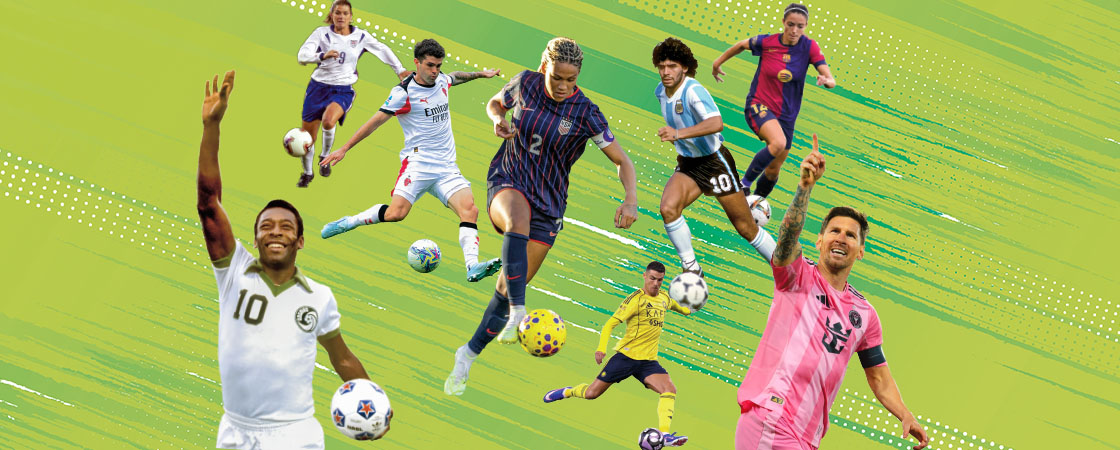
Shutterstock.com (background, World Cup ball); Lengemann/WELT/ullstein bild via Getty Images (leather ball); A. Messerschmidt/Getty Images (Hamm); George Tiedemann/Sports Illustrated via Getty Images (Pelé); Piero CRUCIATTI/AFP via Getty Images (Pulisic); Ringo Chiu/Shutterstock.com (Rodman); Mark Leech/Offside/

GOAL!

The amazing history of soccer.

By Mackenzie Carro
From the May 2026 Issue

Learning Objective: to read a short informational text, then craft a constructed response that includes a claim, text evidence, and commentary. 

Lexile: 1110L

Standards

Maurizio Borsari/AFLO/Alamy Live News

Marta Vieira da Silva

This June and July, after four long years of anticipation, the world will come together for a massive event. Millions of people from across the globe will attend. Billions more will turn on their TVs or computers to watch the action. Together they’ll experience hours and hours of pulse-racing drama—wild elation alongside intense heartbreak, thrilling victories and crushing defeats. There will be blood, sweat, and tears, and only one team will make it through to the end. 

Welcome to the FIFA World Cup, an international soccer tournament in which the 48 top men’s national teams go head-to-head.

This year, the World Cup is being hosted by the United States, Mexico, and Canada. Matches begin on June 11 and end with the World Cup final on July 19. It’s estimated that more than 1 million people will travel to the games in the U.S. alone, and 6 billion will watch at home. 

Why is the World Cup so popular? Because soccer—or football as it’s called in many countries outside the U.S.—is the most popular sport in the world. Played in nearly every country, it has more viewership than any other game. 

But when did this legendary sport get its start? And how did it become the global megastar that it is today?

Transforming the Game

Lengemann/WELT/ullstein bild via Getty Images

In the 1960s, leather soccer balls were replaced with plastic-covered ones. At the 2026 World Cup, a new, special ball—covered in just four panels of plastic and featuring a motion sensor chip—will make its debut.  

The roots of soccer as we know it today can be traced back some 200 years ago to England. However, many cultures around the world have records of soccer-like games being played much earlier. In ancient China, for example, people played a game called cuju, which involved kicking around a leather ball stuffed with fur or feathers. The ancient Aztecs hit a rubber ball across a court with their hips, buttocks, and other body parts—but no hands. 

It was not until the 1800s in England that the soccer we know today took shape. Centuries before, people had begun playing a game that involved passing a ball around with your feet, sometimes called “folk football.” In the 1800s, young boys in England’s public schools started playing a form of the game that would evolve into modern soccer. Schools—and later businesses, towns, and cities—soon formed teams. 

At first, though, everybody was playing by their own set of rules, making it nearly impossible for teams from different places to compete. In 1863, however, a group formed an organization called the Football Association, which established the first set of formal rules for the sport. This standardization helped the game develop into a professional sport, with official leagues forming, players getting salaries, and fans paying to attend matches. 

Soon the more standardized version of the sport spread beyond England. South American countries like Argentina and Brazil, as well as European countries including Italy and Spain, developed their own soccer leagues, styles, and cultures that grew as large and as passionate as those in England. Other countries in Africa, Asia, and North and Central America followed.  

Global Superstars

Lordprice Collection/Alamy Stock Photo

“Folk football” was played across England in the Middle Ages. But the game could get so violent that it was often banned.

Thanks to advances in technology, like cable television in the 1980s and the internet in the 1990s, soccer’s popularity continued to grow. By the early 2000s, a fan in Oklahoma could watch English footballer David Beckham send a ball soaring into a net in Manchester or Brazilian fan favorite Ronaldo Nazário dribble past a defender in Madrid. Superstar players like this had become global celebrities akin to Hollywood movie stars, and soccer had been transformed into a multibillion-dollar industry. 

Today, with the swipe of a finger, you can stream that epic Champions League match, watch endless highlight reels of U.S. women’s star Trinity Rodman, and, when the World Cup starts in June, get instant updates on all 104 matches that will be played.

Continuous and Exciting

Jose Breton/Pics Action/NurPhoto via Getty Images

Kylian Mbappé 

But technology isn’t the only thing that has spurred the love of soccer. It’s also the sport itself. The game is continuous—with players only stopping at halftime— and unpredictable. This means countless edge-of-your-seat moments of drama and excitement. 

Soccer is also a relatively simple game. Unlike other sports that require expensive equipment, all you need is a ball and some space. This makes it easy for anyone to play, attracting all different people from all different places.

So this summer, when you’re watching the World Cup and taking in the huge crowds, towering stadiums, and buzzing excitement, remember that it all started with a ball, some grass, and a drive to play. 

Short Write: Constructed Response

 What three factors contributed to soccer’s rise in popularity? Answer this question in a well-organized paragraph. Use text evidence. 

This article was originally published in the May/ 2026 issue.

Audio ()
Activities (6)
Quizzes (1)
Answer Key (1)
Audio ()
Activities (6)
Quizzes (1)
Answer Key (1)
Text-to-Speech