
Frances Roy—Frankie to everyone who knew her—was 12 the year she left Earth forever.
She didn’t mean to go into space. Not really. She only meant to follow her aunt.
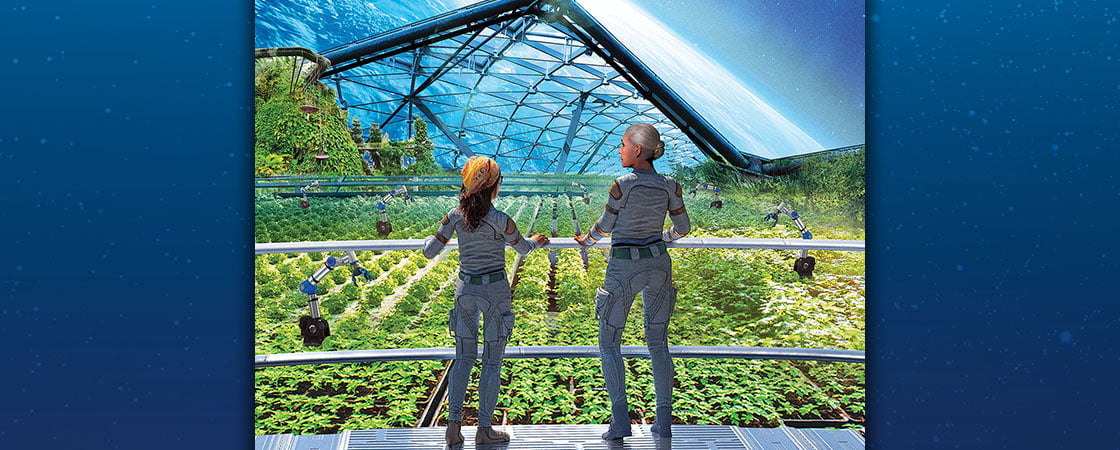
A new home on the moon. A devastating loss. And room to grow.
Learning Objective: to determine the theme of a work of short fiction


Frances Roy—Frankie to everyone who knew her—was 12 the year she left Earth forever.
She didn’t mean to go into space. Not really. She only meant to follow her aunt.

“They keep calling it ‘the experiment,’ ” Aunt Lena said the day the invitation came. “As if it makes it safer to name it that rather than to admit what it really is.”
Aunt Lena’s sister, Jean, looked up from kneading dough. “And what is it really?”
Aunt Lena’s eyes were dark and thoughtful. “We’re leaving Earth. And we’re not coming back.”
Frankie listened from her usual spot on the stairwell, where she could see a slice of Aunt Lena’s face and the steam rising from her cup of tea. The aroma of baking bread and the faint tang of apples drifted through the farmhouse kitchen.
Frankie pressed her knees to her chest. She was young, but she understood more than the grown-ups thought. The planet was changing—floods, droughts, endless fires.
Aunt Lena was a botanist. She devoted her whole life to plants and seeds. The farm where she and Aunt Jean had raised Frankie was peaceful, but it was harder every year to coax food from the soil.
“They’re building ships. Floating cities shaped like glass globes, tethered to the moon so we can study how life might survive in space,” Aunt Lena said. “A new way to live. I don’t know how I feel about it. But they’re pushing for me to come.”
When Frankie crept upstairs that night, she lay awake staring at the ceiling, her mind spinning. An experiment. What would it be like to live surrounded by stars? What would it be like to leave everything behind?
She didn’t know it then, but that was the night that everything began to change.
The next morning, the sun was pale and cold, the fields glazed with frost. Aunt Lena knelt in the garden, trowel in hand, covering the winter beds. Frankie ran to her, breath puffing in the air.
“Take me with you,” she said.
Aunt Lena looked up slowly. “Frankie . . . ”
“I can help! You said I have good hands with the seedlings!”
“That’s true,” Aunt Lena admitted. “But this isn’t a school trip. This is forever. ”
“I don’t care.” Frankie’s eyes stung. “I want to be with you.”
Aunt Jean appeared at the back door, her apron dusted with flour.
“She’s too young,” Aunt Jean said. “It’s dangerous.”
“So is staying here,” Aunt Lena murmured.
For a long moment, no one spoke. The wind whistled through the tall grasses. Dry leaves blew across the hillside. In the distance, a crow called.
In the end, Aunt Lena agreed to participate in the experiment—but under two conditions. She told the committee she would need to bring her life’s work: her collection of seeds, now the size of three storage units. And, she told them, she would need one extra ticket.
“For my apprentice,” she explained simply. “Every experiment needs a future.”
Aunt Jean hugged her sister first. “You’d better live a long life up there,” she whispered.
“You’d better live a long one down here,” Aunt Lena replied.
Then Aunt Jean turned to Frankie, her voice trembling. “Take care of her, OK?”
“I will,” Frankie said.
Adobe Stock
The ship looked like a giant glass lampshade. It spun gently in orbit, a floating city of metal and light. Inside were classrooms, laboratories, gardens, dormitories, and a canteen that smelled faintly like salt, basil, and recycled air.
They called the ship the Globe.
To Frankie, the Globe was both beautiful and terrifying. As the ship traveled, she felt weightless all the time, like she might float away if she let go of anything. The first time she saw Earth through the observation deck window, she gasped. The planet hung below them like a marble—all blue and white, impossibly alive.
“It looks so close,” Frankie whispered.
Aunt Lena stood beside her, her face soft. “Close,” she nodded, “and gone.”
Finally, the ship landed on the moon, tethering itself to the rocky terrain as though to establish roots. This was their new home.
In the greenhouse, kneeling in the soil beside Aunt Lena, Frankie felt grounded again. She learned how to monitor humidity, oxygen, and soil microbes, to record the faint electric signals that told them whether a plant was happy or sad. She set the light timers to mimic Earth’s 24-hour rhythm of day and night. A lunar night could last for days. She tended to rows of bok choy, dwarf wheat, mizuna, and kale—all green and breathing under the artificial lights.
The trees, though, refused to grow.
“They know they’re far from home,” Aunt Lena said. “Earth, that’s the only place they want to take root. Here, they keep resisting. They can’t be tricked.”
Frankie stroked the damp soil where she had placed a lone apple tree seed. “They miss it,” she said. “They miss home.”
Aunt Lena smiled. “I do too.”
Lilian appeared one morning like a shadow between the tomato vines. She was 18, with sharp eyes and a quietness that made people uneasy.
“You’re Lena’s helper,” she said to Frankie.
Frankie nodded. “I guess so.”
Lilian wanted to be a greenhouse assistant, and she came by the garden often after that, drawn in by the smell of soil and life.
“They’re sensitive, these trees,” Frankie said to Lilian one evening, checking the moisture sensors as she peeled away dead leaves from a dying apple sapling.
“They’re homesick,” Lilian replied. “Aren’t we all?”
Sometimes, when the ship dimmed its lights for “night,” the two of them sat in the greenhouse, surrounded by sleeping plants, talking in low voices. Lilian told Frankie stories about Earth—about the oceans Frankie had never seen, about mountains and valleys and bustling cities. About food eaten on street corners on banana leaves, loud, colorful markets, and universities with brick buildings and ivy-covered walls. About the parts of their old home that Frankie never got a chance to explore.
“Did you know,” Lilian whispered, “that on Earth, when an audience watched a play in a theater, their hearts learned to beat in time with one another?”
Frankie thought that was the most beautiful thing she had ever heard. She told Lilian about the farm, about Aunt Jean, about the frogs that sang after the rain. How ripe tomatoes tumbled over bouquets of marigold. Beans and squash and corn emerged from the earth entangled, and radish protected cucumbers from the blight of beetles. She told Lilian about how she would put her ear to the earth and simply listen. The plants would tell her—in their own way—if they were happy or sad. She learned by paying attention.
“I took it for granted, having my feet touching the soil my whole life,” Lilian said one night. “Now I miss it.”
A year passed. Frankie turned 13, growing taller, her hair longer, her hands perpetually stained with soil.
Aunt Lena grew weaker, though she pretended not to. She coughed more often and had to rest a lot between tasks.
Then, one morning, Frankie noticed something extraordinary: a small shoot poking through the damp soil.
“Aunt Lena!” she cried. “Look!”
Her aunt hurried over, leaning on the rail. “An apple shoot! The first to sprout here, in space.”
The whole ship celebrated. People crowded the greenhouse, laughing, clapping. Someone played music. Someone else handed out space cake. To Frankie, everything felt alive again.
But Lilian just stood there, her eyes misty.
Lilian changed after that. She smiled less. She barely came to the greenhouse. Frankie didn’t know why, till one day, late at night, she found Lilian weeping quietly next to the apple shoot.
“Lilian?” Frankie was worried.
“It’s beautiful,” Lilian said, “but beautiful things can be fragile.”
Frankie looked at the tiny green shoot. “Then we’ll take care of it,” she said. “That’s all we can do.”
Lilian wiped her eyes. “I get lonely here sometimes.”
She buried her face in her hands and sobbed.
Frankie wasn’t sure what to say. But she knew what loneliness felt like. She’d felt it on Earth too, at the farm sometimes. And she certainly felt it here, out in space. “Maybe loneliness is just supposed to help us grow,” she said.
Lilian looked at her, surprised. “You’re wise for 13.”
“Almost 14,” Frankie corrected.
Lilian laughed and the sound was small but real. It echoed through the greenhouse, and for a moment, it felt like the plants breathed with her.
The next day, when the ship’s lights slowly came up, Frankie returned to the greenhouse. She looked at the apple tree shoot, its single leaf trembling under artificial light, and wondered if plants were lonely as they grew. If they too were slowly, quietly, reaching toward some sort of light, no matter where it came from.
When Aunt Lena got really sick, the whole ship seemed to hold its breath.
The doctors tried everything, but her heart was failing. Frankie stayed by her side, reading to her from the seed journals, talking to her about the plants.
On her last morning, Aunt Lena asked to see the greenhouse. Frankie helped her there, the corridors humming softly with the ship’s heartbeat.
The apple shoot was taller, like it had been waiting.
Lena smiled weakly before she reached into her pocket and pulled out a small metal box. Inside was a single apple tree seed. “The last one from Earth,” she told Frankie. “From the farm, from our home. For you. Keep it safe. You’ll know where to plant it when the time comes.”
Frankie took it, her fingers trembling, her eyes filled with tears. “I promise.”
That night, Aunt Lena slipped away, her hand still resting in Frankie’s.
The greenhouse lights dimmed automatically at midnight.
Frankie stayed there till morning, whispering to the plants the way her aunt had taught her to all those years ago, her tears falling like rain.
Days blurred together. Frankie worked harder than ever, though everything reminded her of her aunt. The sound of the water pumps. The smell of the soil. And the lonely apple sapling, still trying to grow.
When she wasn’t working, Frankie visited the observation deck. Earth hung below her—blue, distant, silent.
She pressed the seed to her heart. “I’ll find a home for you, I promise,” she said.
Sometimes, Lilian joined her. They’d sit in the quiet, watching the slow rotation of clouds and sea.
A year later, something miraculous happened.
The apple sapling bloomed. A tiny green bump formed on a branch—a bud the size of a marble.
Tiny white blossoms clustered on the branch, glowing faintly under the artificial lights. Their scent filled the greenhouse—sweet and familiar, like spring on Earth.
Frankie felt something warm and steady rise within her. Hope, maybe.
But a week later, the blossoms withered, and the tiny green bump shriveled and dropped into the soil.
Frankie sobbed at the sight.
But Lilian was determined. “We just need to try again. But how?”
Slowly, Frankie reached into her pocket and unearthed the seed Aunt Lena had given her. Carefully, she dug a small hole beside the sapling and placed it in the soil.
“For Aunt Lena,” she said. “And for Earth.”
Lilian knelt beside her, covering the seed with earth. “And for all of us here.”
For a long time, neither spoke.
Adobe Stock
Frankie turned 15, no longer the smallest or youngest on the ship. People came to her for advice now—on which crops to plant, how to balance soil nutrients, how to coax stubborn seeds into sprouting.
She didn’t always know the answers, but she tried. She listened, the way Aunt Lena had taught her. To people and to the seeds. She still put her ear to the soil and tried to understand if a plant was happy or sad.
Sometimes, when the artificial night fell, she still wandered the greenhouse alone, talking to the plants in whispers, telling them stories of wind and rain and the sound of frogs. She realized that, like the plants, she was growing too.
One evening, she found Lilian tending to the seedlings, her hands gentle. And together, they discovered that a tiny shoot had sprung from Aunt Lena’s apple seed.
Lilian smiled at her. “Your aunt would be proud.”
“Maybe she’s listening.”
Lilian glanced at the apple shoot. “Maybe she’s right there.”
The two stood side by side, surrounded by the hum of machines and the faint rustle of leaves.
Many months later, the first apple appeared on a branch, its skin freckled with red. Frankie plucked it carefully and brought it to Lilian.
They split it in half.
“It tastes like Earth,” Frankie said, smiling through her tears.
“Then we did it,” Lilian said. “We brought it with us.”
Frankie nodded. “Maybe home isn’t a place after all. It’s what we grow. And what we grow into.”
She looked at the rows of green, the tiny blossoms, the small new apple tree she had grown.
The space station continued its orbit, a bright bead circling a quiet planet. Inside, the greenhouse pulsed with light—green, alive, and reaching always toward the sun.
And somewhere, deep in the soil, a new seed was already stirring.
Could humans ever live on the moon? Meet Victor Glover, an astronaut helping answer that question.
Robert Markowitz/NASA-Johnson Space Center
Victor Glover
As a kid, Victor Glover was fascinated by the moon. On clear nights, he’d sit in his backyard and stare up at the bright, glowing sphere. He never imagined that one day he’d get a chance to travel to it. But now Glover is an astronaut, and he and three other astronauts are heading to the moon as part of NASA’s Artemis II mission.* Here’s what Glover had to say about this exciting task.
Can you tell us more about the Artemis program?
The Artemis program is like a relay race. Artemis I (November 2022) was the first leg. It proved our spacecraft, Orion, could fly around the moon. Now the baton is with me and my crew. We’re going to fly inside Orion on a 10-day mission where we’ll loop around the moon and return to Earth. If that’s successful, we’ll pass the baton to future missions that may land on the moon.
What’s your job on this mission?
I’m the pilot. It’s my job to know the status of the vehicle at all times. If something isn’t working, I try to repair it or call for help.
NASA/Isaac Watson
The rocket that will take Victor to the moon is 322 feet tall.
Why is it important to travel to the moon?
The Apollo 11 astronauts brought rocks back from the moon. We’re still making discoveries about those same rocks, 50 years later. Sending humans back to the moon is going to give us more tools to study it. The goal of the Artemis missions is to explore new areas, especially the poles. NASA scientists think there might be ice there. If that’s true, chemicals from thousands or millions of years ago could be frozen inside. That could tell us more about the history of the moon, which also helps us learn about the history of Earth.
Alamy Stock Photo
The last time humans landed on the moon was NASA’s Apollo 17 mission in 1972!
What do you love most about being an astronaut?
I get to connect with people all across the country and around the world. When you leave the planet, you represent humanity. Doing this work has given me a lot of respect for the planet that we live on and the people we live on it with. When young people think about the future, I hope the Artemis II mission can be a bright example of what we all can accomplish when we work together and do our best.
* Artemis II is expected to launch between February and April 2026. At press time, a date had not yet been chosen.

Writing Prompt
Think about what Frankie means when she says, “Maybe home isn’t a place after all. It’s what we grow. And what we grow into.” Write a short reflection on this quote, thinking about what it means and how it applies to your own life. Has your idea of “home” grown or changed at all over the course of the school year? What have you “grown into”?
This story was originally published in the April 2026 issue.