
The worst thing about having a terrible secret is the indigestion.
Back to Teacher View
Student View
Art by Jeff Mangiat
The Golden Lie
The truth isn’t always what it’s cracked up to be.
By Sarah McCarry
From the February 2026 Issue
Learning Objective: to determine the theme of a work of short fiction
Complexity Factors
Lexile: 850L
Featured Skill: Theme
Standards



“Josie!” my dad yelled from somewhere farther up the trail. “Come on!”
My stomach burned as I struggled to catch up with him and my brother, the summer sun beating down on my shoulders and the dried pine needles crunching under my boots. We were on our annual father-and-kids trip to Coloma, California. The drive is only two hours from our house in San Francisco, but it feels like traveling to a different country. Out here, it’s just row after row of desolate yellow hills, stretching to the horizon like sleeping giants.
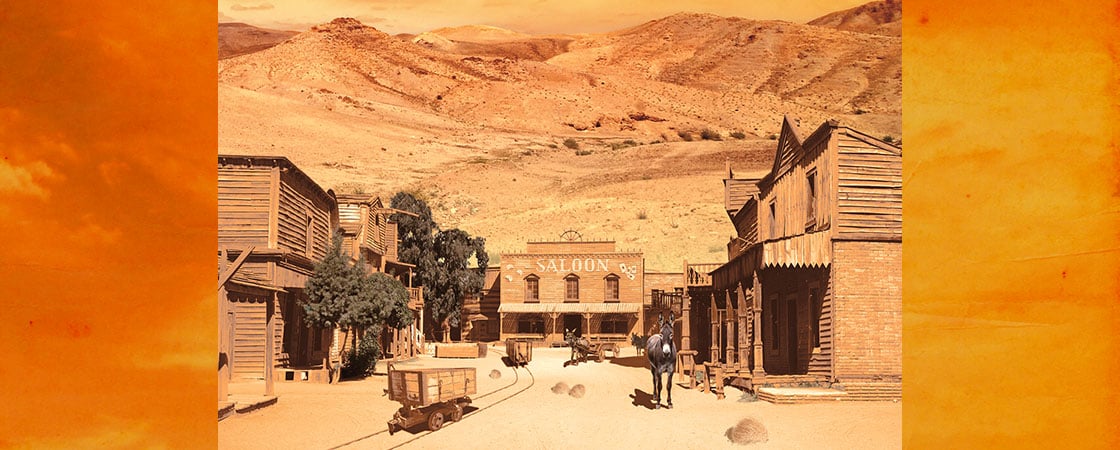
As for Coloma, if you’ve ever seen a movie about the Old West, you know what it looks like: small wooden stores, saloons leaning woozily into dusty streets, the foreboding sense that some outlaws could come riding into town at any moment, looking for a shoot-out.
Not that there are any shoot-outs in Coloma these days. It’s practically a ghost town now and part of a state park. The swaggering marshals who prowl the storied streets are actors in costume.
By mid-morning, we’d seen the museum and a replica of the mill where this guy named James Marshall found gold in 1848. Now my dad was leading us on a hike to help us appreciate how “onerous” (his word) the terrain was for prospectors—people looking for gold. The trail ahead was steep, but I was dragging my feet for a different reason.
“Josephine!” he yelled again.
Scratch what I said about indigestion. The worst thing about having a terrible secret is knowing you’re about to ruin your dad’s life.
Shutterstock.com
The Gold Rush began in 1848 in what is now California after gold was found in a river. Some 300,000 people from around the world arrived there with dreams of striking it rich.
My terrible secret has to do with my great-great-grandfather, who died in 1914. We call him Triple G because “great-great-grandfather” is a mouthful. So is Horatio Algernon Sherman, which was his name. He ran away from home as a teenager to make his fortune out West. (If my parents had named me Horatio Algernon Sherman, I probably would have run away too.) Triple G was part of the Donner Party—the famous doomed expedition to California.
A bunch of pioneers from the Midwest headed out in a wagon train, lured by the adventure of a new life in a new town on a new frontier.And they probably wanted to escape the Midwestern winters too.
But the expedition became stranded high in the Sierra Nevada mountains. Winter snows came, and nearly half the pioneers starved or froze to death. Some resorted to eating the bodies of their dead friends. Only the toughest, like Triple G, survived.
Triple G wasn’t just tough. He was downright heroic. I’ve heard the stories 70,000 times. How he walked in the snow for days, going without food while cutting off pieces of his leather shoes to feed his starving companions. How he carried a sick child for miles. How, when the party was being stalked by a mountain lion—they could see its tracks in the snow—Triple G tracked the cat and wrestled it with his bare hands, and how the meat of that lion helped keep the pioneers alive. To top it all off, when Triple G finally got to California, he totally struck it rich during the Gold Rush and became this wealthy gold miner.
It was my grandfather who first told my brother and me the stories about Triple G, back when we were little kids. Now the stories are my dad’s to tell, and it’s a responsibility he has embraced with great enthusiasm. He tells the mountain lion story every Thanksgiving. He told the shoe leather story at my first slumber party. And did I mention that he collects gold nuggets, old maps of Gold Rush claims, and pickaxes?
My dad always says that my brother and I get our grit from Triple G. Though the stories don’t mean as much to me as they did when I was younger, when I win a medal in track, I do think of Triple G trudging his way through a snowy mountain pass. And when I solve a complicated math problem, I imagine him hooting with glee at the first glint of gold he found on his claim. If I’m honest, it’s hard not to think that, thanks to Triple G, our family is just a little special.
It’s an idea I’ve simply been raised to believe.
So when my history teacher gave us the assignment to write about a historical figure, Triple G was my obvious choice. I wanted to find out what Horatio Algernon Sherman was like before he became the legendary Triple G.
But mostly I wanted to surprise my dad by uncovering a story he didn’t already know.
I spent a long time online looking for information, but there was nothing about Triple G in anything I read on the Donner Party. In fact, there was nothing about him at all. So I rode my bike to the library.
Shutterstock.com
Can I help you?” the librarian asked.
I told him about my project.
“Whoa. The Donner Party?” the librarian said, clearly impressed. “I have just the thing for you. Last year, a family donated a bunch of historical materials, including some very early issues of The Californian, the big newspaper from that time. I can help you look for your great-great-grandfather Horatio Alger—”
“We just say Triple G,” I interrupted. “It’s easier.”
He smiled. “Well, if Triple G was in the Donner Party, you should be able to find something out about his life—especially if he got rich later.”
Then he frowned. “It’s strange that you didn’t find anything online. The members of the Donner Party are all well-known.”
The librarian was right. It was strange.
“You know,” he continued, “most of the people who got rich from the Gold Rush did it by selling supplies to miners at marked-up prices—not by finding gold. Hundreds of thousands of people came from all over the world to seek their fortunes in the desert, but most never succeeded. They all had to buy tools and supplies, though.”
“How do you know all this stuff?” I asked.
“I’m sort of the resident Gold Rush expert here. My family came to California from China during the Gold Rush. Lots of Chinese immigrants did. Do you need help with the microfiche?”
“The micro what?”
“Come on, I’ll show you.”
Microfiche turned out to be old sheets of film that I had to look at on a special projector. Each sheet archived dozens of newspaper articles. A lot of the articles were about places where gold was found—places with great names like Fiddletown and Humbug. There was an article about two politicians getting into a fistfight in a saloon, and another about how excited everyone in San Francisco was that women had started showing up. It had once been mostly men there. There was even an interview with one of the Donner Party survivors.
But there was no mention of a man named Horatio Algernon Sherman.
Hours passed, and I scrolled and scrolled, my eyes glazing. My head started to throb from squinting at all the tiny print. I decided to look through one last paper.
Then, out of the corner of my eye, I saw it: “Algernon.”
Shutterstock.com
COLOMA SHOPKEEPER TO OFFER CASH PRIZE IN SACK RACE
Mr. Horatio Algernon Sherman, shopkeeper, is to offer a cash prize of 5 dollars to this year’s July Fourth sack race winner. Mr. Sherman, recently arrived in Coloma from Iowa, is well-known for his generosity. He hopes his prize will encourage more people to participate in the race.
My heart sank.
Three lines—that was it for Horatio Algernon Sherman. The rest of the newspaper articles were about bored prospectors getting into barroom brawls and breaking people’s windows. The paper was dated June 26, 1849.
I went to get the librarian.
“Hmmm,” he said, reading over my shoulder. “I thought you said he was a prospector.”
“He was,” I said. “This can’t be the same Horatio Sherman, right? My family would know.”
“Where was your Triple G from?”
“Iowa,” I muttered.
“It’s hard to believe that there could have been two Horatio Algernon Shermans from Iowa in California at the exact same time,” the librarian said gently.
He had a point.
“And if this is your Triple G, he couldn’t have come to California with the Donner Party.”
“Why not?” I asked.
“This article is dated 1849, and it says he had arrived recently,” the librarian said. “But the Donner Party set out in 1846.”
This, too, was a point.
Could it be that everything we believed about Triple G was a lie? That he wasn’t a hero at all? That he hadn’t saved children from starvation or killed a mountain lion? That he wasn’t even a prospector? That he was just some guy who’d gone to California, opened a store, and offered a prize for a stupid race?
Shutterstock.com
When I caught up with my dad and brother, they were standing in a shady hollow, sipping water. Spiky desert grass struggled valiantly to thrive in the clearing, and a lone lizard eyed us warily. It wasn’t the lizard who needed to worry, though.
“Dad, I have something to tell you,” I blurted as he handed me a water bottle. “But it’s really . . . not good.”
“What do you mean?” my dad asked, frowning.
“It’s about Triple G,” I said.
And then I told him everything. About the newspaper. About the Donner Party. About the sack race. “He was nothing special, Dad,” I said quietly. “He was . . . ordinary.”
When I finished talking, my brother’s eyebrows were halfway up his forehead. My dad’s expression was even worse. He was just silent, staring at me like a raccoon caught in the beam of a flashlight.
Suddenly, I wanted to take everything back. What harm would there have been in letting my dad keep his stories?
Dad let out a deep sigh. He put his hands on his hips and looked at his feet, kicking at the dirt with the toe of his hiking boot.
“I know,” he said.
My brother and I gaped at him, dumbfounded.
“You know?”
“Well, I wondered,” my dad explained. “When I was little, your grandfather—my father—told me the same stories he told you, and of course I ate them up. As I got older, I realized Triple G’s biography was probably too tall a tale to be entirely true. The idea that someone could survive that terrible expedition, save a bunch of people, and then strike it rich on a claim when hardly anyone who came to California did—it was over the top. But then Grandpa told you kids, and I saw how much it meant to you that Triple G was a hero. I couldn’t take that away from you.”
“But you’re the one who cares so much!” I exclaimed.
“Look, I don’t care that Triple G probably never wrestled a mountain lion,” he said. “What I care about is that he believed in a bigger future for himself. He left behind everything he knew to make the dangerous trek out here—all so he could make a better life for himself, his children, his grandchildren—”
“His great-great-grandchildren,” my brother said.
“Exactly,” my dad said. “He was heroic, in his way. His fortune didn’t come from dumb luck in the gold fields, but from plain old hard work. He built his business all on his own. What could be braver?”
“The newspaper did say he was generous,” I said.
My dad smiled, gesturing for us to follow him. I inhaled deeply, remembering how much I loved the wild, clean smell of desert pine. I wondered if Triple G had felt the same way when he walked these mountains.
That’s when I realized it: I knew exactly what my paper was going to be about.

Writing Prompt
Imagine you are Josie. Write your history paper titled, “My Ordinary, Heroic Triple G.” Be sure to draw on details from the story.
This article was originally published in the February 2026 issue.
Audio
()
Activities
(5)
Preparing to Read
Reading and Discussing
Skill-Building Activities
Quizzes
(1)
Answer Key
(1)
Audio
()
Activities
(5)
Preparing to Read
Reading and Discussing
Skill-Building Activities
Quizzes
(1)
Answer Key
(1)

Text-to-Speech