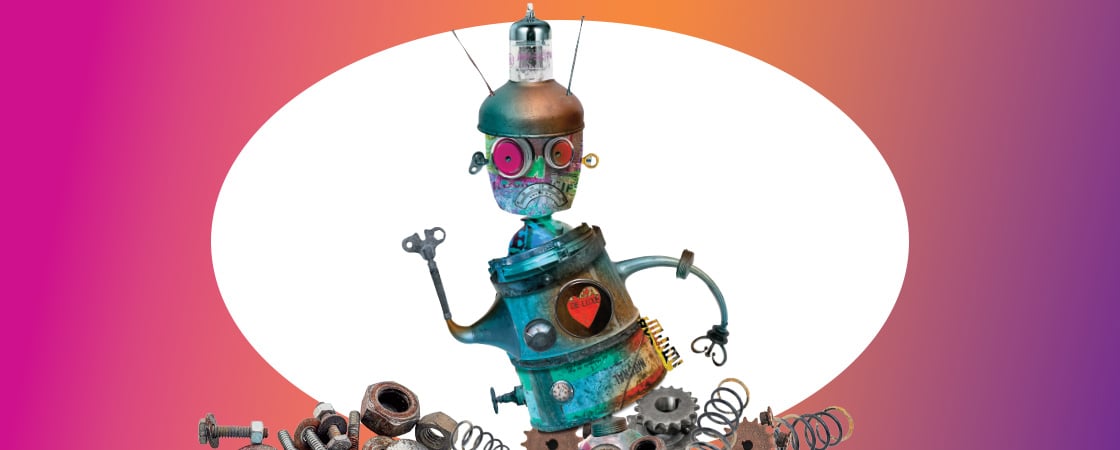

A robot made from an old teapot with a red heart on its chest stands in a pile of bolts, springs, & gears
Art by Pablo Bernasconi

Major Malfunction

Don’t fix it. Don’t fight it. Don’t hide it.

By Tom Angleberger

Learning Objective: Students will synthesize ideas from a personal essay and three interviews.

Lexiles: 740L, 540L

Standards

Story Navigation

Download and Print

Major Malfunction

Don’t fix it. Don’t fight it. Don’t hide it.   

Courtesy of Tom Angleberger

Tom Angleberger

“What’s your major malfunction?”

This was a popular catchphrase in the 1980s.

Not as popular as “Gag me with a spoon” or anything, but you heard it a lot.

Or at least . . . little Tommy Angleberger seemed to hear it a lot.

I associate it most with the fifth and sixth grades.

That was not long after Star Wars came out. “Major malfunction” sort of gave you this picture of a broken robot clanking in circles, spewing smoke, with gears and springs popping out.

It really seemed to sum up how the other kids saw me: a mess; a weirdo; a dweeb; a chatterbox; a blabbermouth; a dork; a jerk; a walking, talking malfunction.

It was more than just an insult. It may have been a very real question: What is wrong with this kid?

Some of my teachers were asking the same thing but with other words.

“What’s your major malfunction?”

This was a popular saying in the 1980s.

Not as popular as “Gag me with a spoon,” but you heard it a lot.

Or at least Tommy Angleberger seemed to hear it a lot.

I associate it most with the fifth and sixth grades.

That was not long after Star Wars came out. “Major malfunction” gave you a picture of a broken robot clanking in circles with gears popping out.

It seemed to sum up how other kids saw me: a mess; a weirdo; a dweeb; a chatterbox; a blabbermouth; a dork; a jerk; a walking, talking malfunction.

It was an insult. But it may have also been a question: What is wrong with this kid?

Some of my teachers asked that question. But they used other words.

. . .

. . .

Shutterstock.com

Let’s be honest . . . I did do some really weird stuff.

Meltdowns. Freak-outs. Sobbing. Tying a plastic Garfield to my hooded sweatshirt strings and swinging it around like a medieval battle-ax or something.

All on full display to my whole class.

Who can blame them for wondering?

Looking back, I can sort of sympathize with them. Especially with one girl, Katrina, who really seemed to hate me.

I can imagine her starting middle school and thinking that she was taking a big step toward adulthood. The silly days of elementary school were behind her, and she was growing up. Things were going to be different in middle school. She’d meet the kids who had come from the other elementary schools, and a new era in her life would begin. A more mature, more sophisticated era would begin.

And then in stumbles Tommy: a child.

A loud child.

A loud, messy, annoying child who always seemed to be in her way and on her nerves. What is this, kindergarten? Can’t that brat just shut up?

Let’s be honest. I did some weird stuff.

Meltdowns. Freak-outs. Sobbing. Tying a plastic Garfield to my hooded sweatshirt strings. Then swinging it around like a medieval battle-ax. All in front of my whole class.

Who can blame them for wondering?

Looking back, I can sort of sympathize with them. Especially with one girl, Katrina. She really seemed to hate me.

I can imagine her starting middle school and thinking that she was taking a step toward adulthood. The silly days of elementary school were behind her. She was growing up. Things were going to be different now. She’d meet kids who had come from other elementary schools. A new era in her life would begin. A more mature era would begin.

And then in stumbles Tommy: a child.

A loud child.

A loud, messy, annoying child who always seemed to be in her way and on her nerves. What is this, kindergarten? Can’t that brat shut up?

. . .

. . .

Courtesy of Tom Angleberger

That’s Tom in middle school!

No, I couldn’t shut up.

That’s the major malfunction (or one of them). 

I wanted to shut up. I would sort of pray for silence. My own silence.

Let me just go to school and just sit there and not say anything. Let me just not . . . malfunction.

That didn’t work.

I couldn’t stop talking. I couldn’t stop having meltdowns. And I couldn’t seem to start growing up.

What was my major malfunction?

Well, what if I didn’t actually have a malfunction?

What if there was something different about me that wasn’t broken?

In fact, what if there was something different about me that really worked?

There was, but I didn’t find out about it for many years.

I was and am autistic.

It wasn’t a word you heard very often back then. Not nearly as often as you heard dweeb, dork, and major malfunction.

And even when I first started learning about it, I didn’t realize it meant me.

But finding out that I was on the autism spectrum was a wonderful thing. A whole lot of stuff started to make sense at last.

Why was I often the only person doing something? Or the only person not doing something?

Why couldn’t I just fit in?

Because I literally didn’t fit in with all those “functioning” people. The place I fit in was “on the spectrum.” And once I knew who to look for, I realized I hadn’t been the “only one.” 

There are lots of us.

I am really proud to belong to this amazing group of people who are also “on the spectrum.” We’re so different, yet connected. 

Plus, the phrase “on the spectrum” is a lot better than “major malfunction.”

What I don’t like, however, is another phrase: “autism spectrum disorder.” 

Disorder sounds an awful lot like malfunction. 

No, I couldn’t shut up.

That’s the major malfunction (or one of them).

I wanted to shut up. I would sort of pray for silence. My own silence.

Let me go to school and sit there and not say anything. Let me not . . . malfunction.

That didn’t work.

I couldn’t stop talking. I couldn’t stop having meltdowns. And I couldn’t seem to start growing up.

What was my major malfunction?

Well, what if I didn’t have one?

What if there was something different about me that wasn’t broken?

In fact, what if there was something different about me that really worked?

There was. But I didn’t find out about it for many years.

I was and am autistic.

It wasn’t a word you heard very often back then. Not nearly as often as you heard dweeb, dork, and major malfunction.

When I first started learning about it, I didn’t realize it meant me.

But finding out that I was on the autism spectrum was a wonderful thing. A whole lot of stuff started to make sense.

Why was I the only person doing something? Or the only person not doing something?

Why couldn’t I fit in?

Because I literally didn’t fit in with the “functioning” people. The place I fit in was “on the spectrum.” Once I knew who to look for, I realized I hadn’t been the “only one.”

There are lots of us.

I am proud to belong to this amazing group of people who are “on the spectrum.” We’re so different, yet connected.

Plus, the phrase “on the spectrum” is better than “major malfunction.”

What I don’t like, however, is the phrase: “autism spectrum disorder.”

Disorder sounds a lot like malfunction

. . .

. . .

And it’s not a malfunction.

Sometimes I call it a superpower.

Think about those superhero origin stories, where the hero gets the powers but doesn’t know how to use them yet. And they make a big mistake and knock over a building or laser-blast something expensive.

Well, I didn’t knock over a building, just annoyed Katrina and a few hundred others for a few years. (Sorry!)

But once I finally got it all figured out, I stopped talking and started typing and drawing.

And out came books.

And people liked (some of) the books.

Maybe because the books were about a kid with a “major malfunction” that was really a superpower.

And maybe because a lot of the readers were kids who had the same superpower.

And the public was obsessed. By the 1890s, bicycle mania was sweeping the United States and the world. Suddenly, it seemed everyone had a bicycle. Factories cranked out bicycles at lightning speed. Singers crooned about the joys of cycling. Writers praised bicycles for making people healthy and strong.

Affordable and practical, the bicycle was for everyone—rich or poor, old or young. With a bicycle, you could go just about anywhere you wanted, whenever you wanted. 

Such freedom of travel had never existed in history.

. . .

. . .

Shutterstock.com

Let’s be honest.

There are a lot of times when this “superpower” still looks an awful lot like a “major malfunction.” There are still times when I should keep my mouth shut and just type it all up later.

But so many of my dreams have come true, from writing Star Wars books to marrying another writer and illustrator, Cece Bell.

In the end, it isn’t really a malfunction or a superpower. It’s just me. I’m not a broken robot or a superhero.

Just a human.

Just a confused kid who hadn’t figured it all out yet—and is still working on it.

Katrina and those other kids (and some teachers) were right that something about me wasn’t working “normally.”

But I wasn’t broken, and I’m glad I didn’t get it “fixed.”

Sure, I might have needed some help understanding and dealing with all of it, but . . . doesn’t everybody need a little help, whether it’s from a book, a song, a friend, a teacher, a therapist, a patient pet, or maybe even a paper finger puppet? (Answer: yes.)

Let’s be honest. There are times when this “superpower” still looks like a “major malfunction.” There are still times when I should keep my mouth shut and type it all up later.

But many of my dreams have come true. I’ve written Star Wars books. I’ve married another writer and illustrator, Cece Bell.

In the end, it isn’t a malfunction or a superpower. It’s just me. I’m not a broken robot or a superhero.

Just a human.

Just a confused kid who hadn’t figured it all out yet—and is still working on it.

Katrina and those other kids (and some teachers) were right. Something about me wasn’t working “normally.”

But I wasn’t broken. And I’m glad I didn’t get it “fixed.”

Sure, I might have needed some help understanding and dealing with it. But doesn’t everybody need a little help, whether it’s from a book, a song, a friend, a teacher, a therapist, a patient pet, or maybe even a paper finger puppet? (Answer: yes.)

. . .

. . .

I’m not sure what kids say today instead of “major malfunction.” But whatever they say, maybe they’ve said it to you.

I’m not going to tell you to ignore it. But I am going to tell you not to believe it.

And for goodness’ sake, don’t try to fix yourself! You might “fix” yourself so that you act more like them, and then where would we be? A world full of Katrinas yelling at each other? No thanks.

No, don’t fix it. Don’t fight it. Don’t hide it. Just have a little faith in it.

Your own combination of malfunction and superpower may have felt clunky today, but it may be exactly what you need tomorrow.

I’m not sure what kids say today instead of “major malfunction.” But whatever they say, maybe they’ve said it to you. 

I won’t tell you to ignore it. But I will tell you not to believe it.

And for goodness’ sake, don’t try to fix yourself! You might “fix” yourself so that you act more like them. And then where would we be? A world full of Katrinas yelling at each other? No thanks.

No, don’t fix it. Don’t fight it. Don’t hide it. Just have faith in it.

Your own combination of malfunction and superpower may have felt clunky today. But it may be what you need tomorrow.

Tom Angleberger is the author of  The Strange Case of Origami Yoda and many other books for kids. In addition to being a weird kid, he was also a short kid. The second shortest, in fact. Which may explain why he likes Yoda so much.

Tom Angleberger is the author of  The Strange Case of Origami Yoda and many other books for kids. In addition to being a weird kid, he was also a short kid. The second shortest, in fact. Which may explain why he likes Yoda so much.

Stories From the Spectrum 

Teeklin, Sophie, and Saoirse are autistic. Here’s what they want you to know. 

Teeklin

Age: 11

Age when diagnosed: 8

Special interests: LEGOs, social justice, Ninjago, Marvel

Age: 11

Age when diagnosed: 8

Special interests: LEGOs, social justice, Ninjago, Marvel

Teen photos courtesy of families

What have you learned from being autistic? Being autistic has taught me how to advocate for myself, which can be scary. Sometimes I’ll tell my teacher that I need a break because I’m dysregulated, and they won’t take me seriously because I’m a kid. But I understand myself and what I need better than anyone, and I wish people would get that. 

What have you learned from being autistic? It has taught me to advocate for myself. That can be scary. Sometimes I’ll tell my teacher that I need a break because I’m dysregulated. And they won’t take me seriously because I’m a kid. But I understand myself and what I need better than anyone. I wish people would get that.

What’s a challenge you face? I have a strong sense of justice and fairness, which sometimes makes it hard to fit in. For example, I’ve seen other kids join in bullying so they can fit in, but I struggle watching someone getting hurt. I’m always ready to stand up for people who are being picked on, even if it means I get picked on myself. 

What’s a challenge you face?  I have a strong sense of justice and fairness. Sometimes, that makes it hard to fit in. For example, I’ve seen kids join in bullying so they can fit in. But I struggle watching someone getting hurt. I’m always ready to stand up for people who are being picked on, even if it means I get picked on myself. 

How do you feel about being autistic? I’m proud to be autistic, which is why I never try to hide it. I wear a lanyard that has sunflowers on it, which is the symbol for invisible disabilities. 

How do you feel about being autistic? I’m proud to be autistic. I never try to hide it. I wear a lanyard. It has sunflowers on it. It is the symbol for invisible disabilities.

Sophie

Age: 17

Age when diagnosed: 17

Special interests: Singing, writing, psychology

Age: 17

Age when diagnosed: 17

Special interests: Singing, writing, psychology

Teen photos courtesy of families

How did getting diagnosed with autism feel? Honestly, I’m still getting used to the idea. I still have a hard time believing it because I don’t look like the stereotypical autistic person I’ve seen represented on TV and in movies—but the autism spectrum is diverse, and I think it’s important for people to understand that.

How did getting diagnosed with autism feel? I still have a hard time Honestly, I’m still getting used to the idea. I still have a hard time believing it. I don’t look like the stereotypical autistic person I’ve seen represented on TV and in movies. But the autism spectrum is diverse. I think it’s important for people to understand that.

What autistic trait do you relate to the most? I have intense interests! Over the years, I’ve been into cooking, baking, singing, acting, playing ice hockey, figure skating, reading, writing, drawing, and photography. 

What autistic trait do you relate to the most?I have intense interests! Over the years, I’ve been into cooking, baking, singing, acting, playing ice hockey, figure skating, reading, writing, drawing, and photography.

What are your hopes for the future? I’m really passionate about protecting children, and I have a lot of plans for how to do that. I hope to start a nonprofit, and I’m also working on writing a few books. One is a chapter book about a young girl who gets targeted by a dangerous person online, and another one is a collection of short stories all about social issues. 

What are your hopes for the future? I’m really passionate about protecting children. I have a lot of plans for how to do that. I hope to start a nonprofit. I’m also working on writing a few books. One is a chapter book about a young girl. She gets targeted by a dangerous person online. Another one is a collection of short stories all about social issues.

Saoirse

Age: 12

Age when diagnosed: 4

Special interests: Dogs, drawing, horror movies

Age: 12

Age when diagnosed: 4

Special interests: Dogs, drawing, horror movies

Teen photos courtesy of families

How did you get diagnosed? I got diagnosed with autism after my preschool teacher noticed some traits in me. My older brother is autistic too—and so is my mom! It’s nice to have people in my family who know what it’s like to be on the spectrum.

How did you get diagnosed? I got diagnosed with autism after my preschool teacher noticed some traits in me. My older brother is autistic. My mom is too! It’s nice to have people in my family who know what it’s like to be on the spectrum.

What’s challenging about being autistic? Sometimes, in social situations, I feel like everybody’s in on something that I don’t know about—like I’m on the outside looking in. An example of this is when someone is talking about one of my special interests, like dogs. I’ll get super excited and start sharing what I know about dogs, but I guess I seem too intense about it because people will just stare at me or walk away.

What’s challenging about being autistic? like everybody’s in on something that I don’t know about. It’s like I’m on the outside looking in. An example of this is when someone is talking about one of my special interests, like dogs. I’ll get super excited. I’ll start sharing what I know about dogs. But I guess I seem too intense about it. People will just stare at me or walk away.

What are you passionate about? I really love drawing and writing stories. I’ve been writing horror stories lately. It takes a lot of practice to build suspense and make things scary for the reader, but I’m working on it.

What are you passionate about? I really love drawing and writing stories. I’ve been writing horror stories lately. It takes a lot of practice to build suspense and make things scary for the reader. But I’m working on it.

Icon of a lightbulb

Writing Prompt

Identify one idea about autism that appears in both the personal essay and the interviews. Explain how each text shows that idea and how it helps readers better understand the autism spectrum..

Writing Prompt

Identify one idea about autism that appears in both the personal essay and the interviews. Explain how each text shows that idea and how it helps readers better understand the autism spectrum.

This article was originally published in the December 2026/January 2027 issue.

This article was originally published in the December 2026/January 2027 issue.

Slideshows (1)
Audio ()
Activities (3)
Quizzes (1)
Answer Key (1)
Slideshows (1)
Audio ()
Activities (3)
Quizzes (1)
Answer Key (1)
Text-to-Speech