
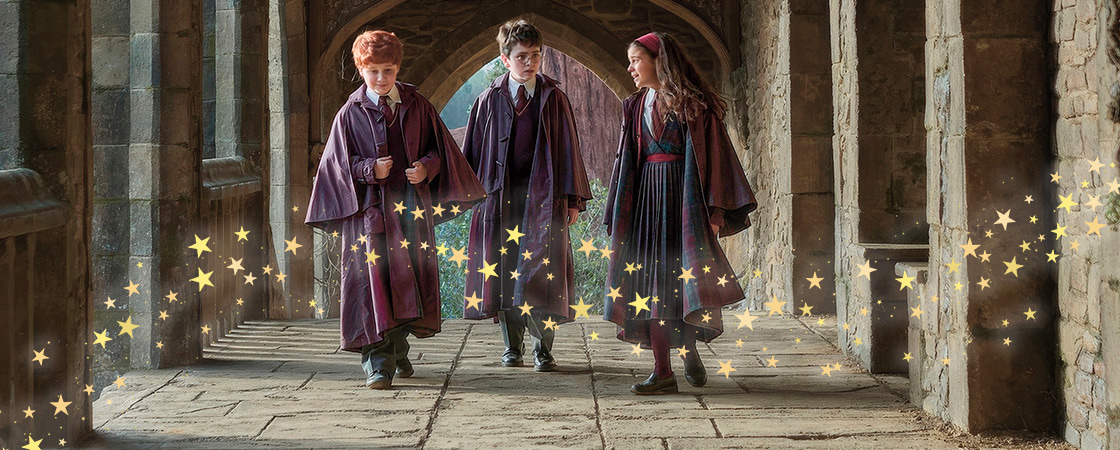

Three children in dark red robes walk through a stone archway as gold stars sparkle around them
Courtesy of Aidan Monaghan/HBO

Building the Wizarding World

Many of today’s movies and TV shows require elaborate sets to create on-screen magic. It’s Mara LePere-Schloop’s job to make that happen.

By the Editors of Scope

Learning Objective: Students will read a short informational text, then craft a constructed response that includes a claim, text evidence, and commentary.

Lexile: 1060L

Standards

Dimitrios Kambouris/Getty Images

Mara LePere-Schloop

A specific brand of laundry detergent from 1991. Jelly lollipops shaped like slugs. An entire forest of ancient-looking trees. What do these things have in common?

They all had to be found—or created—to bring the new Harry Potter TV show to life. And Mara LePere-Schloop is the person in charge of doing that. 

LePere-Schloop is a production designer, which is the head of a film or television show’s art department. Production designers are responsible for working with directors to figure out exactly how a script should look and feel on-screen—and then collaborating with other departments to bring that vision to life. This work includes everything from building elaborate sets to painstakingly crafting props. The result is a brand-new visual world, which—when watching from home—may seem to come together like magic on your screen.

The Big Picture

Shutterstock.com

200+

sets have been built for the new Harry Potter show (so far!)

A set is the physical location or built environment where a TV show or movie is filmed.  In the earliest days of the motion picture industry, most movies relied on set painters to create simple canvas backdrops. Sets gradually became more complex, but the production designer role didn’t really exist until the late 1930s. That’s when the producer of Gone With the Wind—one of the most successful films in history—coined the term to recognize the work of William Cameron Menzies. Menzies created the film’s detailed and stunning sets, transporting moviegoers to a grand Southern mansion and immersing them in a wild inferno as the city of Atlanta burned.

By the 1970s, production design was recognized as an integral part of filmmaking. And today, it’s a huge job. Production designers are hired right from the start of a movie or TV show’s development. They help the director envision everything you see on-screen—from picking real-life filming locations and constructing massive sets to working with the costume and special effects teams to make sure all the visual details work together.

Getting Started

So how do production designers get started on a project? First, they study the script to understand the characters and the setting. From there, they dive into research. If the story takes place in the past, they might look at books, paintings, art, and decor of the time period. If it takes place in the present, they might visit the city or town where the characters live. 

This knowledge then informs every design decision that’s made—whether they’re choosing the perfect 17th-century French teacup for a period film or building a set that’s meant to mimic a modern middle school for a TV show.LePere-Schloop, for example, had to become an expert in Scottish architecture before creating Hogwarts, the fictional boarding school in the Harry Potter series. “I had to think about what Hogwarts would look like, not just in 990A.D., when it was built, but in its evolution from 990 to 1991, when the TV series takes place,” she says. “What additions may have been made, and how had it evolved?” 

Courtesy of Aidan Monaghan/HBO

LePere-Schloop’s team had to think about every detail—furniture, wallpaper, and more—to create Harry’s childhood home.

Making It Happen

Once the research is done and the vision for the project is created, the production designer has to execute that vision. Luckily, they have help. LePere-Schloop’s art department for Harry Potter includes more than 1,200 people. There are artists who draw out plans. There are construction workers, painters, and set decorators. There are people who find props. There are even graphic designers who create book covers and people who make furniture or sew curtains. 

“If you can imagine something, you have the privilege of working with people who can create it,” LePere-Schloop says. “It’s like going to a magic workplace.”

One added challenge for this particular job was having to stay true to the beloved Harry Potter books. To help, an assistant created a “story bible” breaking down the seven books. It described every single set, prop, and creature the show would require, complete with research, sketches, and photos.

Constant Challenges

There’s no one path to becoming a production designer. Many people who go into the field study art, design, architecture, or a combination of those things. But a critical part of the process is getting hands-on experience on set. Most production designers start as assistants and work their way up through the art department on different shows or movies, creating a portfolio of projects as they go. 

LePere-Schloop herself took part in a technical theater program in Detroit while growing up. Starting at 11, she was creating sets and learning about lighting design. She then studied architecture in college but eventually fell back into production design by accident. Luckily, she wouldn’t change a thing.

“I don’t think a single day in my 25-year career has been the same, because you’re constantly given new challenges,” she says. “I can’t imagine a job that would make me happier.”

Short Write: Constructed Response

Based on the article, how is production design a team effort? Answer this question in a well-organized paragraph. Use text evidence to support your opinion.

This article was originally published in the December 2026/Janaury 2027 issue.

Slideshows (1)
Audio ()
Activities (2)
Quizzes (1)
Answer Key (1)
Slideshows (1)
Audio ()
Activities (2)
Quizzes (1)
Answer Key (1)
Text-to-Speech