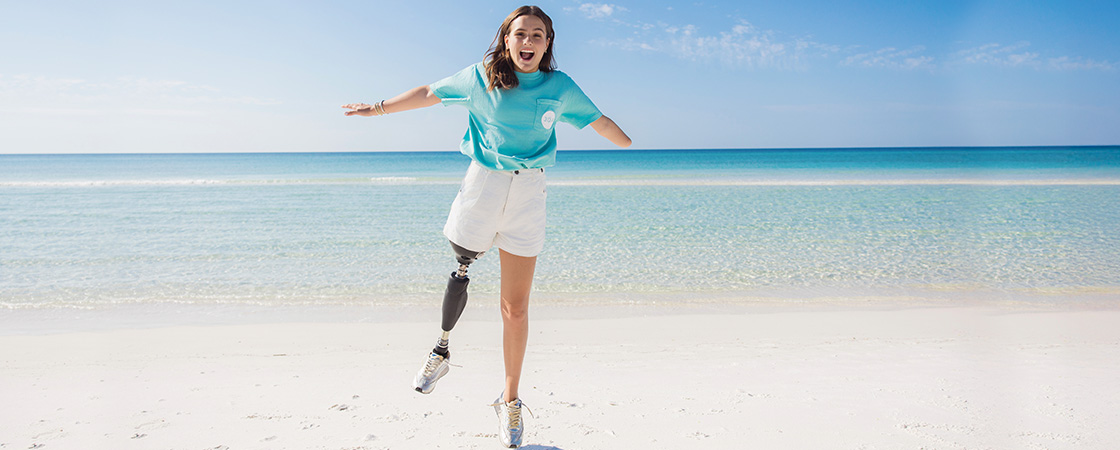

A young woman with a prosthetic leg jumps on a sandy beach with arms outstretched
Guillaume Lechat/Trunk Archive

Unbreakable

A dream vacation. A horrific shark attack. An incredible recovery. Lulu, 18, shows what it means to be unbreakable.

By Kaitlin Menza
From the November 2026 Issue

Learning Objective: Students will analyze how an individual’s actions contribute to a central idea in a text.

Lexiles: 1090L, 780L

Standards

Download and Print

It started off as the perfect beach day.

Lulu Gribbin, then 15, was enjoying a mother-daughter trip to Florida in June 2024 with her twin sister and four of her friends. While their moms grabbed lunch, the girls were swimming in the beautiful jade-green waters at Seacrest Beach, diving for sand dollars and splashing in waves that only reached their waists. 

Then Lulu heard her best friend let out a scream that would change her life forever.

“Shark!”

It was nothing like the movies. Lulu didn’t see an ominous fin slicing through the water or glimpse spiky teeth. She didn’t even get a chance to swim away after hearing her friend’s warning. 

Instead, Lulu followed an instinct she felt to raise her left arm into the sunlight. What she saw shocked her: “There was no hand there—just flesh and bone,” she remembers. “I didn’t ever feel its teeth in me.” 

Another swimmer scooped Lulu up. Then she blacked out. When she regained consciousness, she was lying on the sand, surrounded by a group of strangers who were trying to stop the bleeding. Her twin sister, Ellie, held her head up and her eyes open to keep her awake. 

Everyone tried to block Lulu from the sight of her mangled right leg, which the shark had all but destroyed, but it was too late. Through the crowd, she could spot the pink polish on her toes. “Strawberry Margarita” was the color, she remembers: “A staple for a good summer day.” 

It was the last time she’d ever see her right foot, though Lulu didn’t know it yet. She also couldn’t anticipate that her body was in the process of losing two-thirds of its blood supply—or that her terrifying ordeal was only just beginning. 

It began as the perfect beach day.

Lulu Gribbin was 15. It was June 2024. Lulu was on a mother-daughter trip to Florida with her twin sister and four of her friends. The moms were eating lunch. The girls were swimming in the ocean. They stayed in water that only reached their waists. 

Then Lulu heard her best friend scream. It would change her life forever.

“Shark!”

It was nothing like the movies. Lulu didn’t see a fin or spiky teeth. She didn’t have a chance to swim away. 

Instead, Lulu felt a need to raise her left arm. When she did, she was shocked. “There was no hand there—just flesh and bone,” she remembers. “I didn’t ever feel its teeth in me.”  

Another swimmer scooped Lulu up. Then she blacked out. When she woke up, she was lying on the sand. A group of strangers surrounded her. They were trying to stop the bleeding. Her twin sister, Ellie, tried to keep her awake. 

Everyone tried to block Lulu from seeing her mangled right leg. The shark had all but destroyed it. But through the crowd, she spotted the pink polish on her toes. “Strawberry Margarita” was the color, she remembers: “A staple for a good summer day.” 

It was the last time she’d ever see her right foot. But Lulu didn’t know that yet. She also didn’t know that her body was losing lots of blood. It would end up losing two-thirds. And she didn’t know that her terrifying ordeal was just beginning. 

Apex Predators

Apex Predators

Shutterstock.com

Lulu was bitten by a bull shark.

These days, it might seem like sharks are spotted along the shore all the time. Search TikTok, and you can find perfectly clear videos of these ocean predators showing up near snorkelers or circling boats. Yet the number of shark attacks on humans has dropped significantly in the past six years, says John Carlson, a research biologist studying sharks at the National Oceanic and Atmospheric Administration Fisheries. The chance of being bitten by a shark is 1 in 4.3 million. “I always tell people, you have a better chance of being injured driving to the beach than you do of being bitten by a shark when you get there,” he says.

So why does it seem like shark sightings are more common these days? With drones flying over the sand and a cell phone in everyone’s beach bag, many images of them are being captured and shared. “Anytime something happens, it gets posted on Instagram or Facebook and goes viral,” says Carlson.  

Of course, sharks do pose a real threat to other fish in the sea. As apex predators—animals at the very top of the food chain with no natural predators—they are a key component of the ocean’s ecosystem. Sharks feed on bigger fish like tuna and mackerel as well as squid and sea turtles. Left unchecked, these creatures could overeat the middle-sized fish that consume seagrass and algae, upsetting the sea’s delicate balance. 

But sharks don’t even recognize humans as natural prey, so when the rare attack does happen, it’s often because of the shark’s own fear and confusion. This disorientation can occur in murky water during times of lower light, like sunrise and sunset, when the flash of a shiny bathing suit or a piece of jewelry can make a person resemble a moving fish. 

These risk factors don’t seem to apply to Lulu’s story, though, only adding to the mystery of why she was targeted by the shark. Although she did later learn she wasn’t alone that day—3 miles down the coast, a woman had been attacked just 90 minutes earlier.

It might seem like sharks are spotted along the shore all the time. TikTok has many videos of them showing up near snorkelers or circling boats. Yet the number of shark attacks on humans has dropped significantly in the past six years, says John Carlson. A research biologist, he studies sharks at the National Oceanic and Atmospheric Administration Fisheries. The chance of being bitten by a shark is 1 in 4.3 million. “I always tell people, you have a better chance of being injured driving to the beach than you do of being bitten by a shark when you get there,” he says.

So why does it seem like shark sightings are so common today? Drones fly over the beach. Everyone has a cell phone. As a result, many images of
sharks are being captured and shared. “Anytime something happens, it gets posted on Instagram or Facebook and goes viral,” says Carlson.  

Of course, sharks are a threat to other fish in the ocean. Sharks are apex predators. (Apex predators are at the very top of the food chain. They have no natural predators.) So sharks have an important role in the ocean’s ecosystem. They feed on fish like tuna and mackerel. They eat squid and sea turtles too. Left unchecked, those larger creatures could overeat the middle-sized fish that consume seagrass and algae. That would upset the sea’s delicate balance.  

But sharks don’t see humans as natural prey. So attacks on humans are rare. They are usually a result of a shark’s own fear and confusion. This disorientation can occur in murky water during times of lower light, like sunrise and sunset. The flash of a shiny bathing suit or a piece of jewelry can make a person resemble a moving fish. 

These factors don’t seem to apply to Lulu’s story, though. So her shark attack is a bit of a mystery. Later, Lulu learned she wasn’t the only one. A woman had been attacked just 90 minutes earlier. It happened three miles down the coast.

Early Struggles

Early Struggles

Lulu’s next few days felt like a series of dreams and nightmares, with some images crystal clear in her mind and other details pieced together by her doctors and family. She was taken by helicopter to Ascension Sacred Heart Hospital in Pensacola, Florida, where her medical team decided to amputate nearly all of her right leg. In the immediate aftermath, Lulu fought waves of panic from her hospital bed. “Emotionally, I struggled with the way I looked,” she admits.

At the same time, a tube in her throat that was helping her breathe made it impossible to speak with the family members gathered in her room. She also experienced searing nerve pain and burning aches that seemed to be coming from her absent leg. However, her spirits were lifted by visits from the hospital’s therapy dog, Sherlock. “He came into my room a few times a day, and that was the best part of my recovery,” she says. Guided by his handler, Amanda, Sherlock would snuggle with Lulu in her hospital bed or sit with her through therapeutic activities like painting. “Those moments with Amanda and Sherlock are some that I remember the most,” she says. 

But reality didn’t fully set in until Lulu was transferred to Atrium Health Levine Children’s Hospital in Charlotte, North Carolina, five days later. While there, she also had access to a team of experts at OrthoCarolina Reconstructive Center for Lost Limbs. 

In Charlotte, Lulu endured seven more surgeries. Doctors operated on her injured arm to shorten it and cleaned the bacteria out of her wounds. As she lay in her hospital bed, she couldn’t help but let her mind drift to all her favorite activities. “I used to play volleyball and basketball, and that was really what my life revolved around,” she says. “I was sad that I wouldn’t be able to do those things again.”

Meanwhile, outside the hospital walls, the accident had turned Lulu into a bit of a celebrity. Chatting with her sister and dad one day, she checked her Instagram account and was shocked to see she’d gained 10,000 followers. “We were all laughing,” she says. “We didn’t realize it would escalate.” 

Lulu’s next few days felt like a series of dreams and nightmares. Some images were clear in her mind. Other details were pieced together by her doctors and family. A helicopter took her to Ascension Sacred Heart Hospital in Pensacola, Florida. There, her medical team decided to amputate nearly all of her right leg. In the days after, Lulu fought waves of panic from her hospital bed. “Emotionally, I struggled with the way I looked,” she admits.

In addition, she had a tube in her throat. It helped her breathe. But it made it impossible for her to speak. She also had nerve pain and aches that seemed to be coming from her absent leg. But visits from the hospital’s therapy dog, Sherlock, lifted her spirits. “He came into my room a few times a day, and that was the best part of my recovery,” she says. Guided by his handler, Amanda, Sherlock would snuggle with Lulu in her hospital bed. He sat with her during therapeutic activities like painting. “Those moments with Amanda and Sherlock are some that I remember the most,” she says. 

But reality didn’t fully set in until five days later. Lulu was sent to Atrium Health Levine Children’s Hospital in Charlotte, North Carolina. There, she also had access to a team of experts at OrthoCarolina Reconstructive Center for Lost Limbs. 

In Charlotte, Lulu had seven more surgeries. Doctors operated on her injured arm. They shortened it and cleaned out the bacteria. In her hospital bed, she couldn’t help but think of her favorite activities. “I used to play volleyball and basketball, and that was really what my life revolved around,” she says. “I was sad that I wouldn’t be able to do those things again.”

Meanwhile, the accident had turned Lulu into a bit of a celebrity. Chatting with her sister and dad one day, she checked her Instagram account. She was shocked to see she’d gained 10,000 followers. “We were all laughing,” she says. “We didn’t realize it would escalate.”

Feeling Gratitude

Feeling Gratitude

About two months after the accident, when all the bacteria had been cleared from her leg wound and the amputation area had healed, Lulu was fitted for a leg prosthesis. (A prosthesis is an artificial body part that replaces one that is missing or injured.) That summer, Lulu underwent multiple grueling sessions of physical therapy every day, completing exercises that built up her strength. She also had to relearn basic tasks, like brushing her teeth, going to the bathroom, and putting her hair in a ponytail.  

While the rehabilitation process was taxing, seeing the other people there alongside her pushed self-pity far from her mind. “Honestly, I was one of the better-off patients on the floor,” Lulu says. “There were so many others who had spinal cord injuries or who had dealt with diseases their whole lives.”

The emotion Lulu felt most in those days, she says, was a huge sense of gratitude. And that gratitude, combined with a healthy dose of grit, convinced her medical team that she’d be a great candidate for a new program they were developing for amputees. The overall goal of the program was to reduce pain, and it contained two steps: First there was a surgical procedure, followed by something called targeted brain rehabilitation. As part of this process, Lulu used a virtual reality (VR) headset to help her deal with her phantom limb pain. That’s a painful and often debilitating consequence of limb amputation, in which an amputee feels electric shocks, cramps, or other painful sensations coming from a limb that’s no longer there. 

“In the VR headset, there were multiple games that were aimed at teaching your brain how to control the pain,” Lulu explains. “These games tricked my brain into thinking that I actually did have a left hand so that it would stop causing unnecessary pain.”  

It worked: What had felt like a level 10 of pain in her missing limbs­—the most pain imaginable—was a manageable level 1 by the time she went home from the hospital.

About two months after the accident, the bacteria had been cleared from her leg wound. The amputation area had healed. Lulu was fitted for a leg prosthesis. (A prosthesis is an artificial body part. It replaces one that is missing or injured.) That summer, Lulu had multiple sessions of tough physical therapy every day. The exercises built up her strength. She also had to relearn basic tasks, like brushing her teeth, going to the bathroom, and putting her hair in a ponytail.  

The rehabilitation process was difficult. But other patients were there too. Seeing them pushed self-pity far from her mind. “Honestly, I was one of the better-off patients on the floor,” Lulu says. “There were so many others who had spinal cord injuries or who had dealt with diseases their whole lives.”

Lulu says she mostly felt gratitude. She also showed grit. Those qualities convinced her medical team that she’d be a great candidate for a new program they were developing for amputees. The main goal of the program was to reduce pain. It had two steps: First, there was a surgical procedure. Then there was targeted brain rehabilitation. As part of the second step, Lulu used a virtual reality (VR) headset. It helped her deal with her phantom limb pain. That’s when an amputee feels electric shocks, cramps, or other painful sensations coming from a limb that’s no longer there. It’s a painful and often debilitating consequence of limb amputation.  

“In the VR headset, there were multiple games that were aimed at teaching your brain how to control the pain,” Lulu explains. “These games tricked my brain into thinking that I actually did have a left hand so that it would stop causing unnecessary pain.”   

It worked! Before, the pain in her missing limbs had felt like a level 10—the most pain imaginable. By the time she left the hospital, it was a level 1

Lulu’s Triumph

Lulu’s Triumph

When Lulu left the hospital in late August—77 days after her accident—she was able to walk out, an accomplishment that’s unheard of for most amputees. The hospital staff created a tunnel around her and cheered her on as she stepped out of the facility. “I cried tears of joy,” she says. “It was such an awesome moment.” 

That cheerful exit was just the beginning of her next chapter. Back home in Birmingham, Alabama, Lulu turned her attention again to sports. Basketball and some other team games would require a special wheelchair or extra equipment, but golf could be played by making just a few adaptations. Lulu had also been water-skiing since she was a kid, so she set out to slalom—a version of the sport that involves balancing on just one ski. It took about 15 tries before she could do it. But once she did, “It was the most freeing moment ever,” Lulu says. 

If the story ended there, it would absolutely be a tale of triumph. Yet gratitude once again nudged Lulu forward as she pondered the amazing benefits of that VR headset. “I was one of the first patients to use it,” she says.
“It got me thinking: How can we make this available for other patients? I was walking, I was thriving. I wanted to figure out how to make that a reality for every single person who loses a limb.”

Lulu learned that many amputees lack proper health insurance or don’t live close enough to the places where they can get the best care. So in 2025, she founded the Lulu Strong Foundation, which funds research into prosthetic technologies and new therapies. It aims to close the gap between these advances and the amputees who desperately need them. 

After returning home, Lulu also worked on proposing Lulu’s Law, which would create a system to send emergency alerts to phones in coastal areas when there is a shark attack nearby. It became Alabama law in May 2025. Lulu, in a sleeveless dress the color of Strawberry Margarita, proudly stood next to Alabama Governor Kay Ivey as Ivey signed the legislation into law. 

Earlier this year, a federal version of the law passed as well. Had such a national alert system existed in 2024, Lulu may have not been in the water that fateful day.

Lulu left the hospital in late August—77 days after her accident. She was able to walk out, an accomplishment that’s unheard of for most amputees. The hospital staff created a tunnel around her. They cheered her on as she stepped out of the facility. “I cried tears of joy,” she says. “It was such an awesome moment.” 

That cheerful exit was just the beginning of her next chapter. Back home in Birmingham, Alabama, Lulu turned her attention again to sports. Basketball and some other team games would require a special wheelchair or extra equipment. But golf could be played by making just a few adaptations. Lulu had also been water-skiing since she was a kid. So she set out to slalom—a version of the sport that involves balancing on just one ski. It took about 15 tries before she could do it. But once she did, “it was the most freeing moment ever,” Lulu says.  

If the story ended there, it would be a tale of triumph. Yet gratitude once again nudged Lulu forward. She thought about the amazing benefits of that VR headset. “I was one of the first patients to use it,” she says. “It got me thinking: How can we make this available for other patients? I was walking, I was thriving. I wanted to figure out how to make that a reality for every single person who loses a limb.” 

Lulu learned that many amputees lack proper health insurance. Or they live far from places where they can get proper care. So in 2025, she founded the Lulu Strong Foundation. It funds research into prosthetic technologies and new therapies. It aims to bring these advances to the amputees who desperately need them. 

After returning home, Lulu also worked on proposing Lulu’s Law. It would create a system to send emergency alerts to phones in coastal areas when there is a shark attack nearby. It became Alabama law in May 2025. As Alabama Governor Kay Ivey signed the legislation into law, Lulu stood proudly next to her.

Earlier this year, a federal version of the law passed as well. If that alert system had existed in 2024, Lulu may have not been in the water that fateful day.

Courtesy of Family

Lulu and her family went to Washington, D.C., to advocate for a national alert system for shark attacks. It was signed into law earlier this year.

Two Paths

Two Paths

Today Lulu’s life as a high school senior feels wonderfully normal. Last year, Lulu got her first car, which is adapted with left-foot pedals to allow her to drive, and now she’s thinking about college. “I’ve always wanted to study medicine and become an anesthesiologist,” she says. (That’s a doctor who helps you stay asleep and pain-free during surgery.) “But I also like business ever since creating my foundation.”

Perhaps most astonishing is that Lulu still loves the beach—and doesn’t blame sharks for what happened to her. “I wouldn’t say I’m afraid of them or impressed by them,” she says. “I think they’re just animals.”

It’s an unsurprisingly upbeat outlook from someone whose resilient mindset fueled a remarkable recovery—and helped her turn her life’s worst moment into a higher purpose.

“When you go through a hardship, there are two paths you can take: You can live in the grief, or you can rise above it,” says Lulu. “It was so important to me to come out stronger than I came in.” 

Today Lulu’s life as a high school senior feels wonderfully normal. Last year, Lulu got her first car. It is adapted with left-foot pedals to allow her to drive. Now she’s thinking about college. “I’ve always wanted to study medicine and become an anesthesiologist,” she says. (That’s a doctor who helps you stay asleep and pain-free during surgery.) “But I also like business ever since creating my foundation.”

Perhaps most astonishing is that Lulu still loves the beach. She doesn’t blame sharks for what happened to her. “I wouldn’t say I’m afraid of them or impressed by them,” she says. “I think they’re just animals.” 

It’s an unsurprisingly upbeat outlook from someone whose resilient mindset fueled a remarkable recovery—and helped her turn her life’s worst moment into a higher purpose. 

“When you go through a hardship, there are two paths you can take: You can live in the grief, or you can rise above it,” says Lulu. “It was so important  to me to come out stronger than I came in.” 

Guillaume Lechat/Trunk Archive

A New Passion 

Playing golf has become a big part of life for Lulu since she recovered from the attack. 

Icon of a lightbulb

Writing Prompt

The article is titled “Unbreakable.” Explain how her actions support the idea that Lulu is “unbreakable.” Use evidence from the text to support your response.

Writing Prompt

The article is titled “Unbreakable.” Explain how her actions support the idea that Lulu is “unbreakable.” Use evidence from the text to support your response.


This article was originally published in the November 2026 issue.

This article was originally published in the November 2026 issue.

video (1)
Slideshows (1)
Audio ()
Activities (3)
Quizzes (1)
Answer Key (1)
video (1)
Slideshows (1)
Audio ()
Activities (3)
Quizzes (1)
Answer Key (1)
Text-to-Speech