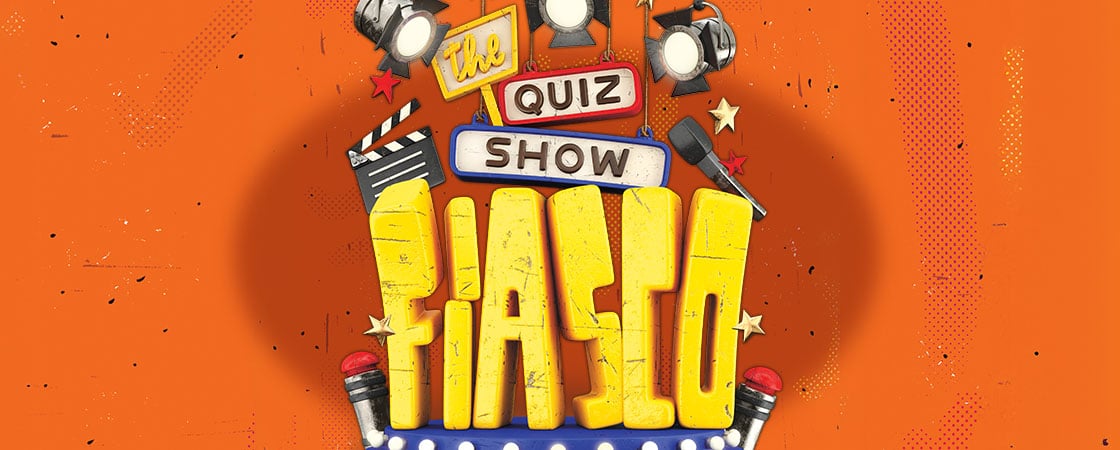
Cover of The Quiz Show Fiasco, bold title with stage lights, microphones, and a clapperboard
Art by Mora Vieytes

The Quiz Show Fiasco

What doesn’t kill you makes you a writer!

By Stacey Lee
From the September 2026 Issue

Learning Objective: Students will read a mini memoir, then use it as a model to write their own.

Lexile: 780L

Standards

Story Navigation

SPOTLIGHT ON: Memoir

A memoir is a true story about an important event or experience in the author’s life. Memoirs are written in first-person point of view, using “I,” “me,” or “mine,” and share not just what happened, but also the author’s thoughts and feelings, helping readers understand why the experience mattered. 

I’m not sure if writers are born. I think they’re built from a series of unfortunate and often humiliating events. Like being picked last for the team. Getting a nosebleed during your oral report. Falling on your face because of a poor choice to run down a hill holding a statue of Beethoven, whose head breaks off and rolls into the gutter. You know, stuff like that.

Of course, there’s good stuff too. But the depths of despair are so rich with possibilities. So ripe with the near-rotten fruit from which the best story jams are made.

Stepping Up

Shutterstock.com

One such unfortunate event happened when I was in sixth grade. The day started with the sad reality that my only clean clothes were red-and-white knee socks and a blue checkered dress. Paired with my yellow clogs, the ensemble gave me a Dutch Fourth of July vibe.

 I hadn’t been thinking about the field trip that day. Our school had been selected to attend the taping of a nationally televised Bible quiz show. At a small school like ours, where studying scripture was part of the curriculum, this was a very big deal. Back then, before streaming or the internet, there were only a few TV channels, so being on-screen felt enormous.

But that morning, I was more concerned about how an unfortunate home perm had left me with what I thought would be permanent ramen kinks in my hair. 

So when I got to school, I was surprised to see buses waiting in the parking lot. Kids were buzzing with excitement. “We could be discovered,” someone whispered. 

Of course, only our two contestants, Debbie and David, would actually be on TV, but maybe the cameras would roll over to the audience.

I regretted wearing the Dutch Fourth of July outfit. I regretted my ramen hair. At least I wouldn’t have to play Frisbee-football that day, which my sixth grade teacher Mr. B made all of us do at regular intervals—even those who hated sports, like me.   

Mr. B was considered “very cool” because he looked like Luke Skywalker. But that morning, he didn’t look very cool, running around with a worried expression on his face. “Has anyone seen David?”

We all glanced around for the motormouthed David, a history whiz who excelled at Bible trivia. Our secret weapon.

Shutterstock.com

No one knew where he was. His parents were called. The office administrator shook her head sadly. “I’m sorry, kids. David is sick.”

A buzz of agitation spread quickly as whispers morphed into moans and moans became wails.

“We can’t go to Hollywood without David!”

“We need another contestant!”

“This is a disaster the likes of which will never be paralleled in this universe!” 

OK, no one actually said that last one, but we were all feeling it.

Mr. B shook his head, his startlingly blue eyes surveying all of us carefully.

As far as I was concerned, we should all just go home.

Shutterstock.com

And then it happened. A voice rose above the chaos: “Stacey can do it. She’s Chinese. Chinese know everything.”

The remark wasn’t “racist” back then—none of us knew what that word meant. But it was certainly a humiliating and discriminatory way of being measured based on membership in a particular racial group. I was the only Chinese girl in the school.  

Sometimes that worked in my favor—people wanted me on their math team—but usually it made me want to disappear into my clogs. Today was one of those days.

Into the Spotlight

Shutterstock.com

I don’t know who said it. But once it was out, the words floated above us like a poisonous mushroom cloud. Everyone was chanting my name. 

Stacey! Stacey! 

My feet started doing some sort of clog dance all on their own, trying to make a run for it. But Mr. B was making his way over to me.

He put his weighty, Frisbee-football-throwing hands on my shoulders. “Stacey, you have to represent the school.”

“What? Not me! I don’t know Bible trivia. I can’t be on TV.” 

The words came out more like “Whaaa . . . nooo . . . bibblia . . . teeveee.” 

I knew the main Bible stories, like Noah and the ark, but not the obscure stuff that Debbie and David had spent months drilling. Whose hair, when cut annually, weighed two hundred shekels? 

“Just give it your best,” Mr. B said. “We’re counting on you.”

We all piled onto the bus, with me in the front seat, all by myself. I cursed David. He had thrown me under the bus. Or in this case, onto the bus. I cursed Mr. B. I cursed my mom for the hair. I cursed Beethoven, because why not?

In the studio, a red stage dazzled with bright lightbulbs that moved on a track, Vegas-style.
A grumpy host wore an ill-fitting suit and stood between two podiums with buzzers. A lady with a plastic smile coached the kids on when to cheer while Debbie and I were brought onstage. It had to be at least a hundred degrees up there. The air felt thick and hard to inhale. How was I going to survive what promised to be a thorough grilling on a subject I barely knew while also being slow roasted like a rotisserie chicken?  

Our opponents arrived, two kids in matching uniforms. They sized us up, just as we sized them up. A look of confusion crossed their faces. But they weren’t looking at Debbie. 

They were looking at me. Their confusion turned to worry, and it hit me. They thought I was the real competition. And for a moment, my panic stalled. I stood a little straighter. Tossed my ramen curls. You better be worried, I thought.

Every good fall is preceded by a spectacular high, and oh, I was soaring. I puffed up like a fighter, swinging my arms, sliding my neck as if to say “You want a piece of this?” 

Can’t be scared if you’re the scary one. 

So, of course, the fall was spectacular. I did not answer a SINGLE question. And every time I went mute, my class erupted in a collective groan.  

My whole body burned as we made our way back onto the bus. All I could think of was how I might need to become an arsonist to prevent that recording from being broadcast on national TV. 

Someone tapped me on the shoulder. “You forgot your consolation prize.” The lady with the plastic smile handed me a neon-orange disc: a Frisbee.

I’m not sure how I survived the ride home. But the point is that I did survive. 

I survived the spectacular fall. Here I am, telling the story. 

For those who want to be writers, my best advice is that you live your life. Chase the highs, the ones that make you feel bold and unstoppable. But don’t run from the lows that sometimes follow.

That’s where the good stories live. The highly uncomfortable moments that slowly roast you alive. The die-of-shame ones you wish you could erase forever. Those are the experiences that shape you. They knock you down, then build you into someone deeper and more interesting—someone who sees the world from a few more angles. 

And one day, if you’re lucky, you’ll turn them into stories worth telling.

Icon of a lightbulb

Writing Prompt

Write a mini memoir about an unfortunate experience from your own life, using Stacey’s advice on writing to tell the story.

This story was originally published in the September 2026 issue.

Slideshows (1)
Audio ()
Activities (3)
Quizzes (1)
Answer Key (1)
Slideshows (1)
Audio ()
Activities (3)
Quizzes (1)
Answer Key (1)
Text-to-Speech