
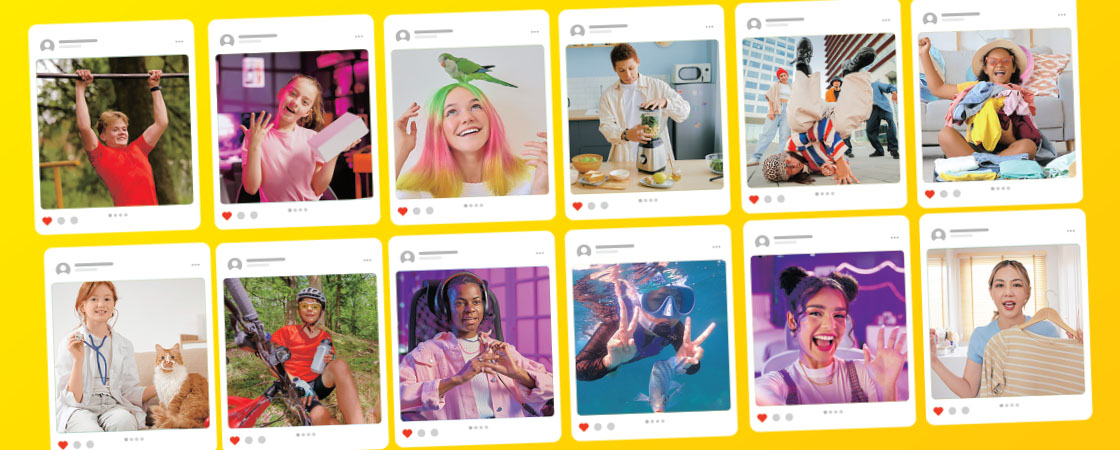

Collage of social media posts showing young people engaged in various hobbies and activities
Cavan Images - Offset (pull up); Westend61 on Offset (blender); Shutterstock.com (all other images)

Are Your Fave Influencers Trying to Trick You?

Be careful. They might be trying to sell you something.

By Tod Olson
From the September 2026 Issue

Learning Objective: Students will read a short informational text, then craft a constructed response that includes a claim, text evidence, and commentary.

Lexile: 1040L

Standards

Sadie Sink is one of the most popular celebrities in the world. When she’s not busy slaying monsters in the Upside Down on Stranger Things or hanging out with pals like Olivia Rodrigo in real life, the actress is all over Instagram and TikTok—where she has more than 32 million followers. Every time she posts to her feed, people pay attention.

Last year, Sadie shared some pics of herself all decked out in Bulgari jewels for the holidays. It might have seemed that she was simply showing her fans some bling from a brand she loves. (And her fans responded: The post got more than 5.6 million likes!) But Sink wasn’t just posting about her fave new finds. She was an official #BvlgariPartner. That means she was being paid to post.

Sponsored Posts

As fans, we love to follow our favorite musicians, actors, athletes, and influencers on social media. We want to know who actress and singer Mckenna Grace hangs out with, or where sweethearts Tom Holland and Zendaya are having dinner while they’re in London. 

And sometimes, celebrities do share personal moments. But other times, these influencers are getting paid to post about clothing, energy drinks, or other products.

When an influencer is getting paid to use or promote a product, their posts are called “sponsored content.” And this content can make a celeb or influencer a pretty penny—some big stars can score millions of dollars for a single post. 

Often, it can be hard to tell whether an influencer is sharing info about a product because they just love it—or because they’re getting paid to promote it. Hashtags that include the words sponsorship, brand partner, collab, or partnership can all give you a clue that the person posting is getting paid. Sometimes posts are labeled clearly, and influencers are up-front about the fact that they’re working with a brand. Other times, an influencer may do things like hide the hashtag #ad behind their profile photo or not disclose that they’re working for a brand until the end of a long video. Why? Research shows that sponsored posts work best if they don’t seem like traditional ads.

Sneaky Ads

This kind of sneaky advertising is nothing new. Companies have been paying to showcase their products on radio, on TV, and in movies for decades. In the 1940s and ’50s, companies sponsored  TV shows so they could put brand names in the show titles. There was, for instance, Kraft Television Theatre and The Colgate Comedy Hour. In the late 1950s, the Studebaker car company paid for a show called Mister Ed. The star was a talking horse, but cars often appeared on-screen as well—and of course, those cars were Studebakers.

In 1982, the movie E.T. proved that this kind of subtle advertising can be powerful. E.T. is about a friendly alien; in one scene, a boy uses Reese’s Pieces to lure the alien to his house. After the movie came out, Reese’s Pieces sales skyrocketed.

Of course, TV and radio commercials used to be a much bigger part of advertising. Today traditional ads or commercials are not as effective as they once were because viewers can record shows and fast-forward through commercials. And many people pay for streaming services that don’t have ads at all.

That’s part of the reason why brands have turned to influencers and celebrities on social media. These stars have the power to reach consumers who tune out traditional commercials.  Plus, their followers trust them. According to a 2025 survey conducted by Better Business Bureau National Programs, 74 percent of Americans say they trust influencers.  

Get Smart

It has gotten harder to sneak ads onto social media though. To keep consumers safe and hold influencers accountable, in 2019, the Federal Trade Commission (FTC) put endorsement guidelines into place. These rules require influencers and celebs to disclose when they have any kind of financial relationship with a brand—whether that’s receiving perks like free makeup or bags, or cold hard cash. To make things clear, the celebrity or influencer must use visible hashtags indicating that they are a brand partner or ambassador, or saying the post is sponsored. In a video, it can even mean making a verbal acknowledgment that they were gifted a product.

But enforcing the rules can be difficult, and many sponsored posts still aren’t labeled properly.

What can you do? Be smart when you check your feeds. Look for products mentioned by name. Then check for hashtags like #ad, #ambassador, #sponsored, or #brandpartner. Remember that getting a lot of likes and shares doesn’t always mean the influencer is trustworthy. 

Finally, ask yourself: Does that influencer really love those sneakers? Or do they love the check they got from Nike last month for promoting them? 

Short Write: Constructed Response

What makes sponsored influencer posts a successful form of advertising? Answer this question in a well-organized paragraph. Use text evidence.

This article was originally published in the September 2026 issue.

video (1)
Slideshows (1)
Audio ()
Activities (2)
Quizzes (1)
Answer Key (1)
video (1)
Slideshows (1)
Audio ()
Activities (2)
Quizzes (1)
Answer Key (1)
Text-to-Speech