
Stage Directors 1, 2, 3 (SD1, SD2, SD3)
*Philippe Hauchecorne, an elderly peasant
*Anne Boyle, a neighbor of Philippe
Maurice Boyle, Anne’s husband
*Luc Turgis, a peasant
What happens when no one believes you?
Learning Objective: Students will analyze how a drama portrays human nature and support their interpretation with evidence from the text.

Scene 1
A Tuesday morning in October, the late 1880s

Shutterstock.com
A centime (sawn-TEEM) was similar to the penny. One franc was worth 100 centimes.
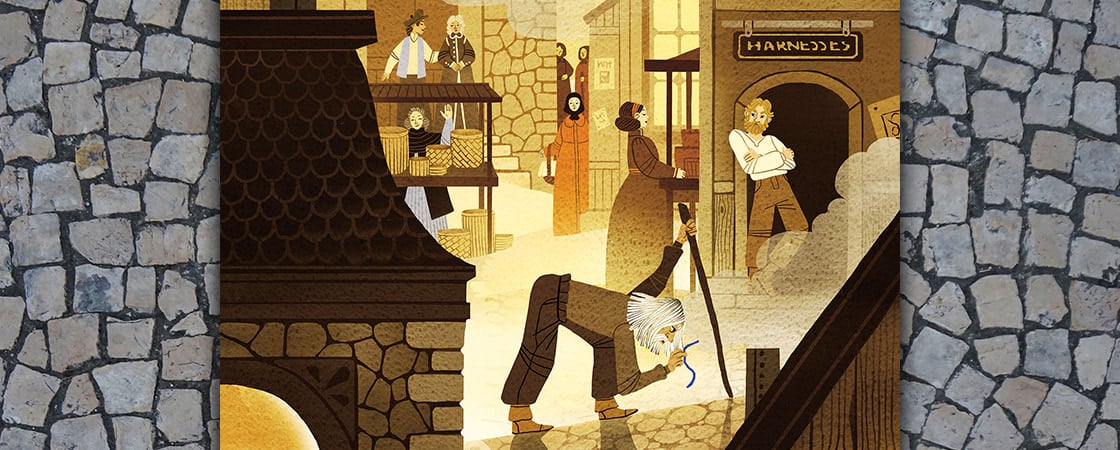
SD1: It is market day in the French village of Goderville.
SD2: People and animals fill the public square, where fresh produce, meats, and other goods are displayed on rough wooden tables and in woven baskets.
SD3: Human voices—gossiping neighbors, crying children, customers haggling over the prices of pumpkins and cheese—mix with the squawking of chickens, the lowing of cows, and the bleating of goats.
SD1: At the edge of the market appears Philippe Hauchecorne. He walks slowly, his joints stiff and sore from rheumatism.
SD2: Spotting something on the ground, Hauchecorne stops.
Philippe Hauchecorne (to himself): A piece of string. Surely this can be of some use.
SD3: With difficulty, Hauchecorne bends down and picks up the string.
SD1: Just then, he notices the local harness maker, Claude Malandain, glaring from the doorstep of his nearby shop.
Hauchecorne (to himself): Oof, it is that scoundrel Malandain.
SD2: Hauchecorne awkwardly shoves the piece of string into his pocket and looks back down as though searching for something.
Hauchecorne (loudly): I must not have dropped anything after all.
SD3: Wincing, Hauchecorne straightens up and continues into the market as Malandain looks on suspiciously.
Scene 2
Jourdain’s Tavern, late that afternoon
SD1: Hauchecorne enters the noisy, packed dining room of Jourdain’s Tavern.
SD2: A lively fire burns in a huge stone fireplace, where chickens, pigeons, and joints of mutton roast on spits.
SD3: Merry diners—peasants as well as members of the higher classes—sit shoulder to shoulder on long benches, passing dishes of food.
SD1: A woman waves to Hauchecorne.
Anne Boyle: Mr. Hauchecorne! Come join us.
SD2: Hauchecorne lowers himself onto a bench across from Anne and Maurice Boyle.
Anne: Good day at the market, Mr. Hauchecorne?
Hauchecorne: Oh yes. I bought some lovely-looking chestnuts.
Maurice Boyle: Hopefully you gave them a close inspection. Plenty of people wouldn’t think twice about taking your hard-earned money for some dried-out, worm-infested nuts.
SD3: Two people sitting nearby join the conversation.
Luc Turgis: Sad but true. You can’t trust anyone these days.
Suzanne Turgis: You said it. I saw a good price on a goat this afternoon, and the first thing I asked myself was “So what is wrong with this goat?”
Luc: What was wrong with it?
Suzanne: Nothing I could see. Surely there was something though.
Anne: I saw Mr. Malandain this morning. He bought a chicken and some apples from me.
Hauchecorne: Hmph. Speaking of people you can’t trust.
Maurice: I take it the two of you are still on bad terms.
Hauchecorne: “Bad terms” is one way to put it. He made a halter for my horse that fell apart in no time and refused to refund a single centime. The very sight of him makes my blood boil.
Anne: Malandain tells a different version of that story, you know. He says he made it clear that for the price you offered, he’d have to use inexpensive leather. He says he warned you it wouldn’t hold up to heavy use.
SD1: The conversation is interrupted by a drumbeat out on the street.
SD2: The tavern patrons rush to the windows.
Town Crier (from outside): Attention, all persons present at the Goderville market this morning! Between 9 and 10 o’clock, a black leather wallet was lost. It contained five hundred francs.
Anne: Oh dear.
Maurice: Bad luck.
Town Crier: A reward of 20 francs is offered for the wallet’s return. It can be delivered to the mayor’s office or directly to Mr. Fortuné Houlbrèque of Manneville.
SD3: The tavern patrons drift back to their tables.
Suzanne: Do you think that man will get his wallet back?
Luc: I doubt it. I would return it, but most people are not so honest.
Maurice: I agree. Most people would take the 500 francs and throw the wallet in the river.
SD1: The chatter continues as people finish their meals. They are interrupted again when the Corporal of Police comes through the tavern door.
Corporal of Police: Is Philippe Hauchecorne here?
Hauchecorne: Yes, here I am.
Corporal: Will you kindly come with me, sir? The mayor would like to speak to you.
SD2: Frowning, Hauchecorne slowly gets up and follows the corporal out.
Scene 3
The mayor’s office, a short time later
SD3: The mayor sits behind an enormous desk as the corporal and Hauchecorne enter.
Mayor: Mr. Hauchecorne, this morning you were seen picking up the wallet lost by Mr. Houlbrèque.
Hauchecorne: I—what? I did no such thing!
Mayor: You were seen by Mr. Malandain.
SD1: Hauchecorne’s face turns red.
Hauchecorne: Oh, he saw me, did he?
SD2: Hauchecorne reaches into his pocket and takes out the piece of string he found earlier.
Hauchecorne: This is what he saw me pick up!
Mayor: Surely you do not expect me to believe that a respectable man like Malandain mistook a piece of string for a wallet.
Hauchecorne: I swear I am telling the truth!
Mayor: Corporal, does this story seem likely to you?
Corporal: No, Mr. Mayor, I cannot say that it does.
Mayor: Corporal, please bring in Mr. Malandain.
SD3: The Corporal steps out and returns a few moments later with Malandain.
Mayor: Please tell us what you witnessed this morning.
Malandain: I saw this man pick up a black wallet near the entrance to the market.
Hauchecorne: I never—
Mayor: Quiet, please. Mr. Malandain, continue.
Malandain: He then searched the mud to see if any money had fallen out.
Mayor: Thank you, Mr. Malandain. We will not take up any more of your time.
SD1: Malandain exits.
Hauchecorne: This is all a terrible mistake! The truth is, I was embarrassed. I did not want Malandain to know I was picking up a piece of string, so I hid it from his view. Then I pretended to search for something I had dropped.
Corporal: Why were you embarrassed?
Hauchecorne: I am an economical man. I hate to see something useful like a piece of string go to waste. But that man already thinks I am cheap, and I did not care to confirm his views.
Mayor: You will forgive me if I find all of this hard to believe.
SD2: Hauchecorne turns his pockets inside out. He removes his hat and his boots and shakes them.
Hauchecorne: Do you see? No wallet. I am an innocent man!
Mayor: Hmm. You may go, but expect to hear from me soon. I am going to ask the public prosecutor what he recommends.
SD3: On his way out, Hauchecorne pauses and turns back to the mayor.
Hauchecorne: This is a travesty of justice! A travesty of justice, I tell you!
Shutterstock.com (Guy de Maupassant); Art by Pau Ham
Who Was Guy de Maupassant?
The French writer Guy de Maupassant (1850-1893) is considered to be one of the masterminds of the modern short story, having written hundreds during his successful career. Many of them expressed a negative view of human nature. Do you think this story is one of them? Why or why not?
Scene 4
Outside the mayor’s office, moments later
SD1: A small crowd surrounds Hauchecorne as he exits the office.
Maurice: What happened?
Luc: Are you going to be arrested?
Suzanne: Did you return the wallet?
Anne: Why didn’t you speak up sooner?
Hauchecorne: I never saw the wallet!
Luc: That’s not what we heard.
Hauchecorne: What you heard is slander! Malandain saw me pick something up, but he didn’t see what it was. When he heard about the missing wallet, he jumped to the conclusion that I had taken it. But all I picked up was a piece of string—a little piece of string!
Crowd: Ha-ha-ha!
Luc: That’s a good story! I’ll have to remember that one for my grandchildren.
Suzanne: Sure, Mr. Hauchecorne, sure. And I saw a talking chicken at the market today!
Crowd: Ha-ha-ha!
Maurice: What a rogue you are, Hauchecorne.
Crowd: What a rogue!
Anne: It’s getting late, Mr. Hauchecorne. Why don’t we head back to the village together?
Hauchecorne: We’ll pass right by where I found the string. I’ll show you.
Maurice: Oh yes, you do that.
Crowd: Ha-ha-ha!
Scene 5
Jourdain’s Tavern, the following week
Shutterstock.com
SD2: Hauchecorne bursts into the tavern, which is once again packed with people.
SD3: He goes to the table where Anne and Maurice are again sitting with Luc and Suzanne. He speaks to everyone within earshot.
Hauchecorne: Did you hear? My innocence has been proved! A farmhand found the missing wallet and returned it.
Luc: That farmhand sure took his time.
Hauchecorne: The young man cannot read. It took him a while to determine who the wallet belonged to.
Anne: Everyone has already heard this story.
Suzanne: But no one believes it.
Luc: What we believe is that the farmhand was your accomplice. You had him return the wallet after you were accused.
Suzanne: I wonder: What did you give that young man as payment for his role in your little scheme?
Maurice: A piece of string, perhaps?
Crowd: Ha-ha-ha!
Anne: Just admit what you did, Mr. Hauchecorne, and we can all move on.
SD1: Hauchecorne’s face has turned a deep shade of red. His breathing is fast and shallow.
Luc: Come on now, you’re getting all wound up.
Crowd: Ha-ha-ha!
Hauchecorne: Why doesn’t anyone believe me? It’s bad enough to be accused of stealing, but to be accused of lying is simply unbearable!
SD2: Hauchecorne stumbles out of the tavern.
Scene 6
Jourdain’s Tavern, three months later
SD3: Maurice and Anne sit with Suzanne and Luc, eating dinner.
Suzanne: Sad news about Mr. Hauchecorne.
Anne: The saddest part is how he spent the last few months of his life. He could speak of nothing but that nonsense with the string.
Maurice: He told his story to anyone who would listen, adding more detail with each telling. Last time I saw him, he described the string’s exact shade of blue.
Luc: As though that would convince you of his innocence!
Anne: The poor man was obsessed. I don’t think he was eating or sleeping.
Suzanne: Perhaps it was the guilt weighing on his heart that killed him.
Anne: Father Lambert was with Mr. Hauchecorne when he died. He told my friend Lucette that Hauchecorne’s last words were “A little bit of string—a little bit of string—see, here it is, Mr. Mayor.”
SD1: A brief silence falls over the table. Several people shake their heads.
SD2: Then the moment passes.
SD3: People return to their meals, and a lively conversation resumes. •

Writing Prompt
The play’s text features explain that many of Maupassant’s short stories expressed a negative view of human nature. Do you think this story is one of them? Why or why not? Answer in a short essay. Use text evidence.
This article was originally published in the December 2026/Janaury 2027 issue.