*Stage Directors 1, 2, and 3
(SD1, SD2, SD3)
Storytellers 1 and 2
*Nainai, Kai’s grandmother
*Kai, a 12-year-old boy
Mrs. Yang, Kai’s history teacher
What would you do to forget?
Learning Objective: Students will determine the theme of a drama and support their thinking with key details from the text.

Prologue
Five years ago, Nainai’s house

SD1: The stage lights come up to reveal a cozy living room. Young Kai sits on the floor, fidgeting with a tablet.
SD2: From a plush couch, Nainai watches him with a knowing expression.
SD3: Two storytellers stand downstage, talking directly to the audience.
Storyteller 1: In some Chinese traditions, memory is not something you keep forever.
Storyteller 2: Before souls can be reborn, they must forget.
SD1: Nainai pours a small cup of tea.
Nainai: You know that in our culture, after we pass, we are reincarnated, yes?
Kai: Mm-hmm.
Nainai: And before we are reborn, we must forget our family, our memories, every moment of our lives.
Kai (distracted): Uh-huh.
Nainai: A woman named Meng Po waits at the edge of the next life. She gives each soul a tea that erases their memories. After drinking it, the soul can begin again.
SD2: Kai nods but is clearly more interested in the video on his tablet.
Nainai: There are also fox spirits—huli jing—that can take the form of humans and tempt you. They are drawn to people who want something very badly. You must be careful when making deals with strangers.
Kai: That can’t be real.
Nainai: Maybe. But these spirits are clever, and they desperately want what they don’t have: human emotions, memories, experiences.
SD3: Nainai studies Kai more closely now, her tone growing more serious.
Nainai: Remember this, Kai: Forgetting may feel like a gift. But it is not meant for the living.
SD1: Kai shrugs, unimpressed.
Storyteller 1: Time passes. The child grows older.
Storyteller 2: And the warning fades, just as quickly as it was told.
Who Is Meng Po?
This play combines elements of Chinese religious traditions and folklore to tell a mystical story set in present-day China. One such element is the character of Meng Po (above). In Chinese folklore, Meng Po is a figure in the afterlife who serves a potion of forgetfulness (in this play, it’s a tea). This potion allows a soul to leave memories of their past life behind so that they can be reincarnated, or born again. While stories of her origin differ, Meng Po is almost always described as a wise old woman who assists with this transition.
Scene 1
Present day, Kai’s middle school
SD2: Kai, now 12, stands at the front of a classroom, holding a stack of note cards.
Mrs. Yang: Go ahead, Kai.
SD3: Kai takes a deep breath before speaking.
Kai: Today I’ll be talking about the Qing dynasty. Lasting from—um—
SD1: He glances at his note cards, noticing that they are out of order.
SD2: He quickly flips through them, becoming flustered.
Mrs. Yang: Take your time.
SD3: Kai nods, finds his place, and starts again.
Kai (confidently): The Qing dynasty lasted from 1644 to 1912.
SD1: As Kai talks, a low murmur begins somewhere in the room.
SD2: A few students lean toward one another, whispering through sly smiles.
Student (pointing): There’s something in your teeth!
SD3: Laughter breaks out.
SD1: Kai freezes, covering his mouth, his face flushing.
SD2: One card slips from his hands, then another. In his rush to grab them, Kai drops the whole stack.
SD3: As the laughter builds, Kai quickly scoops everything up, turns, and hurries out of the room.
SD1: In the hallway, Kai slides down against the wall. His brow is sweaty, his cheeks beet red.
Kai (quietly): This is the worst day ever.
SD2: The classroom door opens. Tao steps out and walks over to Kai.
Tao: Hey . . . you OK?
Kai: Totally. I’m fine. It’s no big deal.
SD3: Tao sits with him.
Tao: That didn’t look fine.
Kai: Yeah, well, it wasn’t great.
Tao: If it helps, I’ve done worse. At my old school, I fully face-planted in front of an entire school assembly.
Kai: Seriously?
Tao: Yes. People talked about it for days.
SD1: Kai looks at Tao, his tension easing.
Kai: That’s so much worse.
Tao: Right?
SD2: The boys sit there for a moment, letting the silliness of the situation wash over them.
Tao: Anyway, if you want, we could hang out after school tomorrow—you know, study together and swap more stories of complete and total humiliation.
Kai (laughing): Yeah, that sounds good.
SD3: The classroom door opens again.
Mrs. Yang: Kai? Tao?
SD1: The boys stand and head back in together.
Scene 2
That night, a street in Kai’s town
SD2: Kai walks alone down a quiet street, hands in his pockets. His eyes are heavy with exhaustion.
Kai: Why can’t I just forget what happened?
SD3: As he ruminates, he pays little attention to where he’s going. He turns down a narrow alley—and slows.
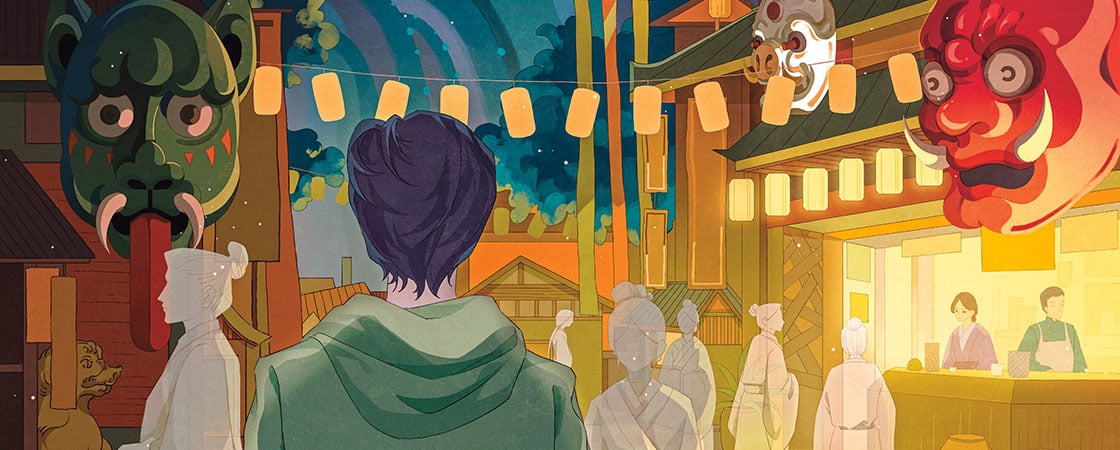
SD1: Lanterns flicker ahead. Strange voices drift through the dark. Dim lights spread across the stage to reveal a market lined with stalls.
Kai: Where am I?
SD2: He moves slowly into the market, taking in unfamiliar objects on tables as vendors glance up at him.
SD3: Some call out softly, their voices blending into a low, hypnotic hum.
All Vendors (softly): Hmmmmmmmmmmm.
SD1: The deeper he goes, the louder the market’s drone becomes.
All Vendors (loudly): Hmmmmmmmmmmm.
SD2: Kai reaches a small tea stall. Two vendors stand behind it. One leans forward with a smirk, while the other stands just behind, still and watchful.
Tea Vendor 1: You look like something is troubling you, young man.
SD3: Kai stops, caught off guard.
Kai: Huh?
TV1: People don’t find this place unless they want something.
Kai: I–I–I didn’t even know this place existed!
TV1: And yet here you are.
SD1: The vendor lifts a small cup of tea, steam curling around him.
TV1: This can help you forget your troubles.
Kai: I never said anything was bothering me!
SD2: The tea vendor raises an eyebrow.
SD3: Kai studies the cup.
Kai: You can make me forget just one thing?
TV1: The tea, yes. It can help you forget.
Tea Vendor 2: But only if you’re certain.
SD1: Kai looks up as if he’s daydreaming.
SD2: From offstage comes a muffled laugh.
Student (offstage): Hahahahahaha!
Kai (to himself): Why can’t I forget what happened?
Student (louder): Hahahahahaha!
Kai: OK, yes, I’m sure! Take my humiliation away.
SD3: He takes the cup and drinks.
Kai (wincing): Ugh. That tastes awful.
SD1: He lowers the cup and hands it back.
Kai: Thanks, I guess.
SD2: Kai turns and walks away, disappearing into the market. As he does, the storytellers appear downstage.
Storyteller 1: Just like that, a choice has been made.
Storyteller 2: A process has begun.
Storyteller 1: And it will not be so easily undone.
Shutterstock.com
What Is a Ghost Market?
Ghost markets are predawn or overnight markets where vendors sell secondhand, antique, or unusual goods. Traditionally lit by lanterns, the markets’ dim lighting helped inspire their eerie name. While the origin of these markets can be traced back to the late Qing dynasty, only a few remain today, with some of the most popular found in Beijing.
Panjiayuan Antique Market (above) is host to one of Beijing’s famous ghost markets
Scene 3
The next day, Kai’s school cafeteria
SD3: The cafeteria is loud and crowded.
SD1: Kai steps inside. Across the room, Tao spots him and waves him over.
Tao: There you are! I thought you weren’t coming.
SD2: Kai pauses, confused, before walking over.
Tao: Hey, so are you coming to my house after school?
Kai: I-I-I’m not sure what you mean.
SD3: Tao laughs, but the look on Kai’s face remains.
Tao: We made plans? To study for Friday’s exam?
Kai: Um, I . . . um, I don’t remember that.
Tao: We talked about it in the hallway yesterday, right after your presentation.
Kai (shaking his head): I just took a quick break and then went right back to class.
Tao: What? Don’t you remember? We bonded over our embarrassing moments.
Kai: I guess I just forgot.
Tao (upset): You don’t just forget something like that overnight.
SD1: Kai lets out a short, uneasy laugh.
Kai: Maybe I did? Yesterday was a lot for me.
SD2: Tao watches him for a moment.
Tao: So . . . do you still want to hang out?
Kai: I can’t. I have dinner with my grandma tonight.
SD3: Tao nods, a questioning look on his face.
Tao: Sure, yeah, another time, then.
SD1: As the boys go back to eating their lunch, a light illuminates the storytellers.
Storyteller 2: A small crack forms.
Storyteller 1: Not just in the friendship—but deep within Kai.
Scene 4
That evening, Nainai’s house
SD2: The house is quiet. Kai walks down a hallway lined with family photos: snapshots of birthdays, holidays, vacations.
SD3: Tonight, one of them makes him pause.
Kai (cringing): Ugh, I remember feeling so embarrassed by that haircut. How could you let me out of the house like that?
Nainai: It was a very cute haircut for a 5-year-old!
SD1: Kai steps closer, leaning in to study it.
Kai: Who’s the man with me in this picture?
Nainai: What was that?
SD2: Kai points to the photo, still focused on it.
Kai: That man. Who is he?
Nainai: Kai, you know him—my husband, your yéye.
Kai (puzzled): No, no. I would remember my yéye.
Nainai: This was at his last birthday party, remember? The last time we all gathered, before he passed.
SD3: Nainai studies him, searching his face.
Kai: I . . . I don’t remember that.
SD1: His voice shakes.
Kai: Am I supposed to?
SD2: Nainai exhales slowly and grabs Kai’s shoulders, turning him to face her.
Nainai: Kai, tell me where you were last night. I know you weren’t in your room.
SD3: The two move into the kitchen.
SD1: Nainai sits Kai down at the table and pushes a cup of tea toward him.
Kai: I went out. I was upset. I couldn’t sleep, so I just started walking. And I found this place . . . a market. There were lanterns, and people, and—
SD2: He takes a long pause.
Kai: —these tea vendors. They gave me something to drink. Said it would help me forget.
Nainai: What kind of market?
Kai: I don’t know. There were all these stalls and—and they were selling so many different things, and . . .
SD3: Nainai frowns at him. When she speaks again, her voice is steady but urgent.
Nainai: Kai, you need to go back.
Kai: What? No, I can’t!
Nainai: Whatever they gave you—this is not normal.
Kai: I didn’t think it would do anything.
Nainai: That is exactly why it is dangerous.
SD1: She lays a hand on his shoulder and crouches down to look him in the eyes.
Nainai: Your memories are part of who you are, even the ones that hurt. You cannot choose to erase them without losing something more.
SD2: Kai glances back at the photo.
Kai: What if I already have?
Nainai: Then you must not wait any longer.
Scene 5
Later that night, the ghost market
SD3: Kai returns to the dark alley where he found the market. Lanterns flicker weakly as he walks in.
SD1: Kai moves quickly through the stalls, ignoring the drone of the vendors calling out to him.
All Vendors (menacingly): Hmmmmmmmmmmm.
SD2: He approaches the tea stand. The vendors are there, but their appearance has changed.
SD3: They are now foxes with sharp features, glinting eyes, and ethereal tails swaying behind them.
TV1: Ah, Kai, you have returned.
Kai: Where are the tea vendors? Who are you?
TV1: We are exactly who you met before.
Kai: No, that can’t be.
TV1: You were told stories of us, weren’t you?
Kai: No, no. You can’t be . . . huli jing.
TV1: Clever fox spirits. Master tricksters.
TV2: We take many forms, but tonight there is no need to pretend.
TV1: You were warned, yet you chose to trust us anyway.
Kai: You need to fix this!
TV1: Fix what?
Kai: My memories. They’re disappearing. I forgot someone I shouldn’t have.
TV1: That is how it works.
Kai: You said I would forget one thing!
TV1: I did. But I never said it would stop there.
TV2: You only heard what you wished to hear.
Kai: You must reverse it!
TV1: Why would we? Your classroom memory was so valuable. Your embarrassment, your regret, your worst emotions? Those are what I crave most, and you have so many left.
Kai: That’s not fair.
TV1: You made a deal.
SD1: Kai stands still, his hands clenched at his sides.
Kai: I could give you something better.
TV1 (laughing): Oh, what a delight! And what would that be?
Kai: I understand now. These memories—the bright parts I ignored and the painful parts I couldn’t—they make me who I am. I can’t lose them.
SD2: Kai steadies himself.
Kai: I can offer something you might crave more. A stronger memory, one full of love. One with my grandmother.
TV1: Ah . . . pure love. Such a priceless emotion. What do you ask in exchange?
Kai: You stop the forgetting. You give me the embarrassing memories back.
SD3: The first huli jing tilts his head, intrigued.
Kai: They were humiliating, yes, but they hold pieces of me that I don’t want to lose forever.
SD1: Before the first fox can respond, the second cuts in sharply.
TV2: That’s enough.
TV1: That wasn’t the deal.
TV2: He understands now. He knows what forgetting costs. That is lesson enough. Return his memories.
SD2: The first huli jing exhales, then nods grudgingly before turning back to Kai.
TV1: The forgetting will stop. What is yours will return.
Kai: Thank you.
What Is a Huli Jing?
A huli jing is a fox spirit from Chinese folklore known for its ability to shapeshift, or change its physical form or appearance. These spirits are said to move between the spirit and human worlds, where they may trick, test, help, or tempt people. In some legends, huli jing absorb a person’s qi, or life force, to strengthen their shapeshifting powers and extend their lives. Some traditions describe powerful huli jing as having multiple tails, with more tails often representing greater age and supernatural power.
Epilogue
The next week, Kai’s middle school
SD3: The lights come up in the classroom again. Kai stands at the front, note cards in hand.
Mrs. Yang: Whenever you’re ready.
SD1: Kai glances down, then up. He begins, but a few cards slip from his hands and scatter across the floor.
SD2: Whispers travel around the room.
SD3: Kai crouches, gathers the cards, and stands again—this time smiling briefly at Tao.
Kai: Hopefully, this goes better than last time.
SD1: A few students laugh with him, and Kai continues.
SD2: The storytellers appear one last time.
Storyteller 2: It’s not perfect.
Storyteller 1: But Kai holds tightly to what he nearly lost in the market.
Storyteller 2: And this time, he won’t wish to forget.
Thank you to Gang Liu, a professor of Chinese Studies at Carnegie Mellon University, for his help with this play.

Writing Prompt
Write a 30- to 60-second movie trailer script for The Ghost Market. Your trailer should capture the theme and mood of the play. Include these words somewhere in your trailer: exchange, humiliation, hypnotic, memory, tempt.
This play was originally published in the September 2026 issue.